
Harlow Dogs vs Other UK Greyhound Tracks
 Available in US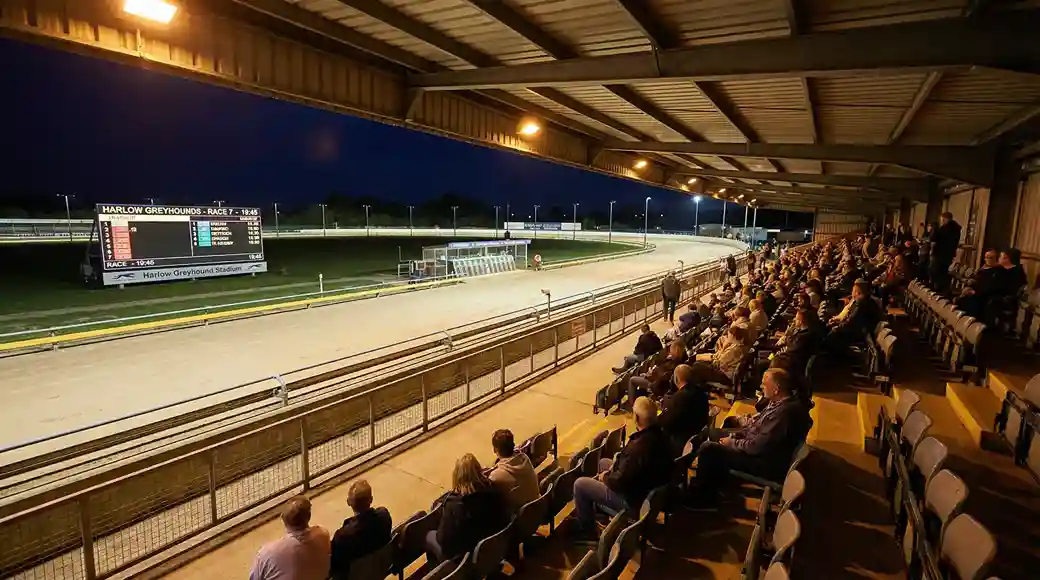
How Harlow Compares to Other GBGB Tracks
Harlow’s 354-metre oval and five distance options put it in specific company within the UK greyhound track landscape. It’s a small-to-medium circuit with a tight first bend, a short home straight and a configuration that rewards early pace over late stamina. These characteristics shape every race run there — and they differ meaningfully from tracks with longer straights, wider bends or different surfaces.
Understanding how Harlow compares to other tracks matters for two reasons. First, if you follow dogs that transfer between venues, you need to know how the track change affects performance. Second, if you’re considering expanding your betting beyond Harlow, knowing other venues helps you decide where your analytical approach will transfer most effectively.
This guide compares Harlow to other prominent UK tracks across size, race quality, betting markets and the tactical demands each circuit creates.
Compare tracks starting from harlowdogresults.
Track Size Comparison — Harlow, Romford, Crayford and Beyond
Smaller tracks favour pace; larger tracks favour stamina. This is the broadest generalisation in greyhound racing, but it holds as a reliable baseline.
Harlow’s 354-metre circumference places it among the smaller GBGB venues. Romford, at approximately 375 metres, is slightly larger but still compact. Crayford sits in a similar category. These Essex and South-East London tracks share a profile: tight bends, short straights, and race dynamics heavily influenced by the break and first-bend position. At all three, the dog that leads into the first turn wins disproportionately often.
Towcester, in Northamptonshire, is the largest licensed circuit in the UK, with a 420-metre circumference. Its longer straights and more gradual bends reward stamina, sustained speed and the ability to pass on the outside. Dogs that wouldn’t get a look at Harlow — moderate trap speed but strong finishing kicks — can be competitive at Towcester because the track gives them room to close the gap. Racing distances include 480 and 500 metres — the latter being the English Greyhound Derby distance — compared to Harlow’s standard 415.
Nottingham, Monmore Green and Perry Barr represent the Midlands circuits. These tend to fall between the tight Essex tracks and Towcester’s expansive layout, offering a moderate balance between pace and staying power. For punters, the Midlands tracks often produce more open, less predictable racing because the characteristics don’t overwhelmingly favour one running style. The variety of outcomes at these venues can be appealing if your analytical approach is flexible, but it also means that pace-based strategies — which work reliably at Harlow — need supplementing with form-reading and stamina assessment.
Track size affects data comparability between venues. A calculated time of 26.00 seconds at Harlow over 415 metres tells you nothing about what that dog would clock at Towcester over 480 metres. When a dog moves between tracks, the grading office at the new venue will trial it and assign a grade based on its performance there, not on its record elsewhere. Treat transferred form with fresh eyes.
Race Quality and Grading Standards by Track
Open-race quality varies — some tracks attract stronger fields because of prize money, prestige and the kennel population in their area.
Towcester hosts the English Greyhound Derby, guaranteeing it receives the best dogs in the country during the competition. Outside the Derby, its regular graded racing tends to be strong because quality kennels are based within travelling distance. The concentration of top trainers near a track has a direct effect on the strength of its cards.
Harlow draws its racing population primarily from Essex, Hertfordshire and East London kennels. The regular graded programme is competitive within its grade structure, but the overall standard is a tier below the premier tracks. Harlow’s open-race nights bring in stronger dogs from further afield and offer the most testing competition on the calendar.
Romford benefits from proximity to Central London, a large catchment area and strong commercial appeal. Its meetings often feature on Sky Sports Racing, which increases betting volume and attracts trainers who want the visibility for their kennels. The quality of racing at Romford tends to be slightly above Harlow in the upper grades, though the lower grades are comparable across most Essex tracks.
For punters, the practical implication is this: form figures from higher-quality tracks carry more weight than those from smaller venues. A competitive A3 dog at Towcester is likely faster than an A3 dog at a smaller circuit, even though the grade label matches. When dogs move between tracks, adjust your expectations based on the relative quality of racing involved.
Betting Market Depth at Different UK Tracks
Bigger tracks mean more betting volume and tighter odds. Tracks with television coverage, larger audiences and higher turnover produce markets where the odds more accurately reflect the runners’ true chances.
At Towcester during Derby season, markets are the deepest in greyhound racing. Prices are set by a large pool of informed money, and inefficiencies are harder to find. At Harlow on a regular Wednesday evening, the market is thinner. Fewer punters are engaged, the bookmakers’ pricing may be less refined, and individual bets can influence the market more readily. For sharp punters, thinner markets at smaller tracks can be an advantage — your analysis is competing against fewer informed opinions.
Morning BAGS meetings at any track tend to have the thinnest markets. These sessions are contracted for betting-shop and online coverage, and the pricing is often set by algorithm rather than specialist traders. Thorough form work on a Harlow morning card may reveal odds that don’t fully reflect the true probabilities — creating value that wouldn’t exist at a premium evening meeting.
Exchange markets for greyhound racing are thinner than for horse racing across all tracks. Liquidity is best at televised evening meetings and weakest at morning sessions and smaller venues. If your strategy involves exchange or lay betting, focus on the meetings with the most liquid markets.
Pick the Track That Suits Your Style
Specialise in one or two tracks before spreading thin. Every punter who’s tried to follow six tracks simultaneously has learned the same lesson: depth of knowledge at one track beats surface knowledge across many. The form, the traps, the trainers, the grading habits, the way the track plays in different conditions — all of this is track-specific intelligence that compounds with every meeting you study.
If you already follow Harlow, it’s a solid base. The track runs frequently, the form data is accessible, and the small-circuit dynamics reward pace-based analysis — which is the most transferable skill in greyhound betting. If you want to add a second track, Romford or Crayford are natural choices because the racing characteristics are similar enough that your analytical framework carries over. Adding a larger track like Towcester expands your range but requires adjusting your methodology to weight stamina and late pace more heavily.
See local races in our greyhound racing in Essex.
The worst approach is to bet on whichever track has the next race. Without track-specific knowledge, you’re guessing — and the market, thin as it may be, has better guesses than yours. Pick your tracks, learn them deeply, and let the fixture list tell you when to bet. The specialist who knows one track intimately will always outperform the generalist who dabbles across a dozen. Depth creates edge; breadth dilutes it. Start at Harlow, learn the circuit’s personality, and build outward only when you’ve genuinely mastered your home ground.
