Greyhound Grading System in the UK Explained
 Available in US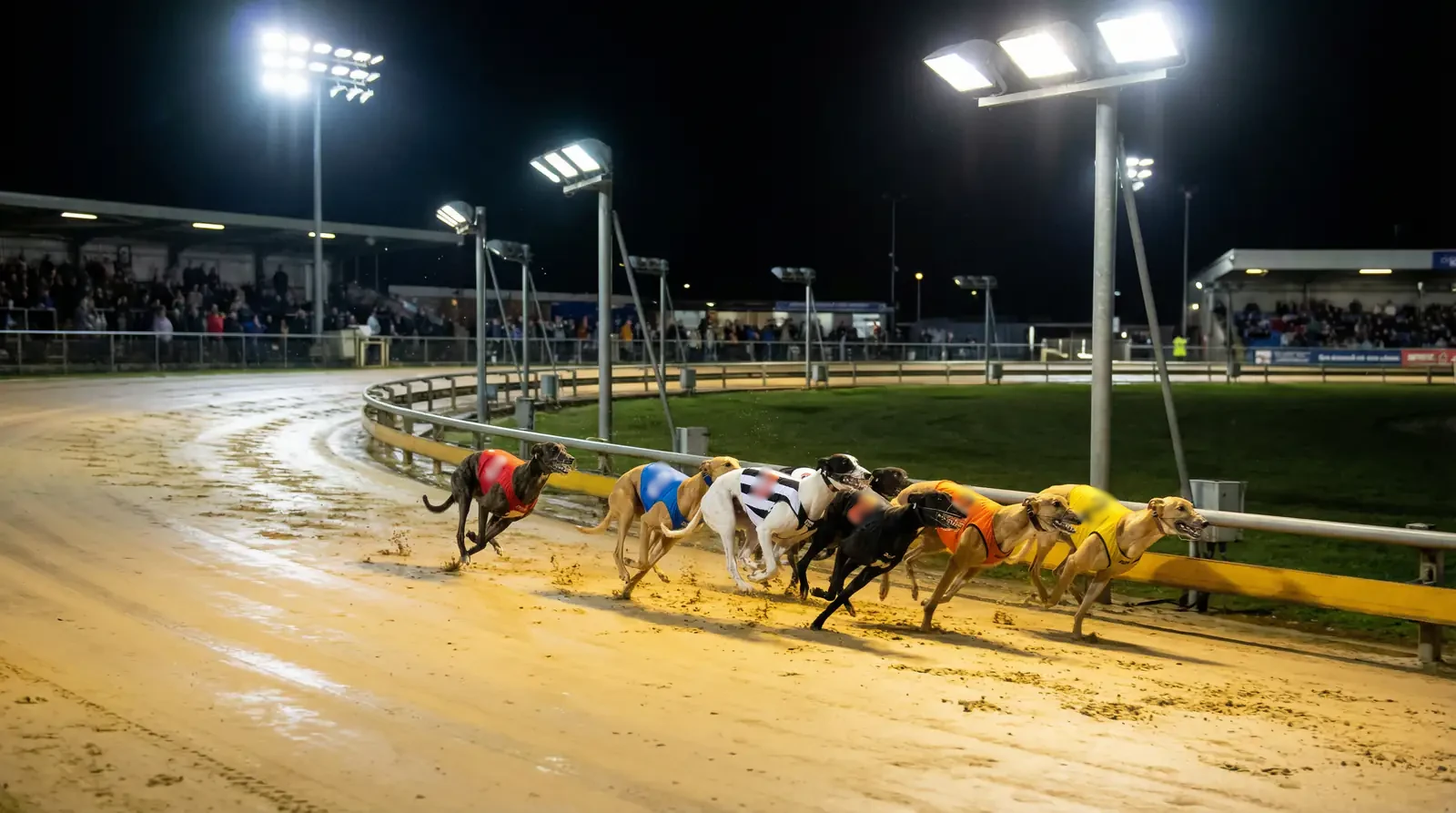
Grading Is Matchmaking — Not Ranking
Greyhound grades don’t tell you which dog is best — they tell you which dogs race together. That distinction matters more than most punters realise. The grading system exists to create competitive fields, not to rank individual animals on some absolute scale. A dog graded A4 at Harlow isn’t automatically slower than an A4 dog at Nottingham, because grading is track-specific: each stadium sets its own grade boundaries based on the times recorded over its particular distances and surface.
This local nature of grading is the first thing bettors need to internalise. An A3 at a small, tight track might clock times that would put it in A5 at a larger circuit. The numbers aren’t transferable between venues, which means that dogs switching tracks often find themselves regraded — sometimes to their advantage, sometimes not. For punters, this creates opportunities that only appear if you understand how the system works.
The grading system also serves a welfare function. By grouping dogs of similar ability, it reduces the risk of mismatched races where one dog dominates and others are put under excessive pressure. The Greyhound Board of Great Britain oversees the framework, but individual track racing managers apply it based on local conditions and running times.
Learn more about greyhound racing at harlowdogresults.
Treat the grade as context, not conclusion. It tells you the type of race, the level of competition, and the approximate speed range of the field. The rest — which specific dog wins — still depends on form, fitness, trap draw and dozens of other variables.
How the A1-A12 Grading System Works
A1 is the fastest grade at a track; A12 is the slowest. The letter “A” denotes graded racing at the standard distance for that track — typically around 415 to 480 metres in the UK, depending on the circuit. Races at other distances use different letter codes: “D” for middle-distance races, “S” for sprints, and “OR” for open races, which sit outside the regular grading ladder.
The grade a dog receives is primarily determined by its calculated time over the standard distance. When a new dog arrives at a track, it’s trialled over the standard trip and given an initial grade based on the time it records. From there, race results — specifically finishing times, winning margins and form — determine whether the dog moves up, stays put, or drops down the grading ladder.
Calculated time deserves a specific explanation because it’s not the same as actual finishing time. Calculated time adjusts the raw finish time to account for trouble in running — being bumped, checked, or slowly away. If a dog finishes in 26.30 seconds but was impeded at the first bend, the racing office might assess its calculated time as 26.10, reflecting what it could have run without interference. This adjusted figure is what the grading system uses, which is fairer to dogs that encounter traffic but can also create discrepancies between a dog’s graded ability and its recent results.
At Harlow, graded races cover the distances of 238, 415, 592, 769 and 946 metres. Each distance has its own grading bands, though the 415-metre trip dominates the card and carries the most granular grade structure. Sprint and staying grades tend to have fewer divisions simply because fewer dogs race at those distances regularly.
Within each grade, the racing office assembles fields by matching dogs with similar calculated times. The goal is a competitive race where no single dog has an overwhelming advantage. In practice, the office also considers running style when possible — seeding railers towards inside traps and wide runners towards outside traps — though this isn’t always achievable, particularly at lower grades where the pool of available dogs is smaller.
The system also includes “open” races, which sit above the graded structure and feature the best dogs at a track or invited runners from elsewhere. Open races aren’t bound by the A1-A12 framework and typically attract stronger fields with more variable form, making them a different betting proposition entirely.
Upgrades, Downgrades and Class Drops
When a dog wins, it goes up a grade — and that changes everything. The upgrade rule is the most important mechanism in the grading system for bettors, because it directly affects the value equation every time a dog returns to the track after a win.
A dog that wins an A6 race will typically be upgraded to A5 for its next outing. The logic is sound: the dog has proven it’s better than its current grade, so it should face stiffer competition. But the reality on the track is more complicated. A dog might win an A6 race because of a perfect trap draw, a weak field, or a fortunate run that avoided all interference. Being upgraded to A5 after such a win means it now faces genuinely faster dogs — and the market often doesn’t fully adjust for that.
Conversely, a dog that finishes consistently outside the top three in its current grade may be downgraded. A series of poor results at A4 could see the dog dropped to A5, where it faces slower competition. Class drops are where experienced punters find some of their best value, because a downgraded dog isn’t necessarily a worse dog — it may simply be one that ran into trouble, drew badly, or raced out of condition in its previous outings. If the reasons for the poor form are temporary and the dog is now facing weaker opposition, the odds often overstate the difficulty.
The timing of upgrades and downgrades matters too. Racing offices don’t always move dogs immediately after a single result. A dog might be given one or two more runs at its current grade to confirm the trend before being moved. Paying attention to which dogs are “due” an upgrade or downgrade — based on recent form — can help you anticipate grade changes before they happen and position your bets accordingly.
Dogs returning from injury or a layoff present another grading nuance. A dog that hasn’t raced for several weeks may retain its previous grade, but its fitness and sharpness could be diminished. The grade says A3, but the dog’s current condition might be closer to A5. These returning runners are often overbet because the market anchors on the grade rather than the dog’s likely performance level after time off.
Multiple consecutive wins can also lead to rapid upgrades. A dog that wins at A8, then A7, then A6 is being pushed up the ladder quickly. At some point, the dog reaches its ceiling — the grade where it can compete but can no longer dominate. Identifying where that ceiling sits is one of the more rewarding analytical challenges in greyhound betting.
How Grading Affects Betting Value
A dog dropping in class is a potential overlay — if you know why it’s dropping. The grading system creates systematic pricing inefficiencies that attentive punters can exploit. These inefficiencies arise because the market tends to react to recent results without fully accounting for the context that the grading system provides.
The most common opportunity comes from class drops. A dog that’s been racing at A3 and getting beaten by faster rivals might look poor on recent form. But if it drops to A4, those same form figures need reinterpretation. The dog wasn’t slow — it was outclassed. At a lower grade, against slower opponents, the same running times might be good enough to win. The market often underestimates this recalibration, pricing the dog based on its losing streak rather than its relative ability in the new grade.
Upgraded dogs present the opposite opportunity. A recent winner moving up a grade attracts market confidence because of its winning form. But the upgrade means tougher competition, and the dog’s winning time at A6 might only be average at A5. Fading recently upgraded dogs — particularly those that won from fortunate circumstances rather than dominant performances — can be a profitable angle.
Grade also affects how you should weight form data. A dog’s times and positions from A4 races aren’t directly comparable to its times from A2 races. The competition level is different, the pace of the races is different, and the tactical dynamics shift. When analysing form, always note the grade of each previous race and adjust your expectations accordingly. A third-place finish in an A2 might represent better underlying ability than a win in A6.
Open races sit outside this framework entirely and require their own assessment. Dogs entering open-race events from the graded system are stepping into stronger, more variable fields. Their grade gives you a baseline, but the open-race context demands additional analysis — particularly around how they handle stronger early pace and more competitive finishes.
Grade the Race Before You Grade the Dog
The race’s class tells you the ceiling; form tells you who reaches it. When you look at a race card, the grade is the first filter. It tells you the approximate ability level of the entire field, which sets the context for everything else you analyse — times, positions, trap draws, trainer patterns.
A dog with a fast calculated time at A5 is competitive in A5 races. Whether it’s competitive in A3 races is a different question. The grade frames the analysis, and punters who skip it are essentially evaluating form in a vacuum.
See how how sectional times work.
Over time, developing a feel for what each grade means at your track — what times are competitive, what running styles dominate, which trainers perform well at specific levels — is one of the most durable edges you can build. Grades change. Dogs move up and down. But the structural dynamics of each grade level remain broadly consistent, and that consistency is the foundation for repeatable analysis.
