
Greyhound Betting Bankroll Management Guide
 Available in US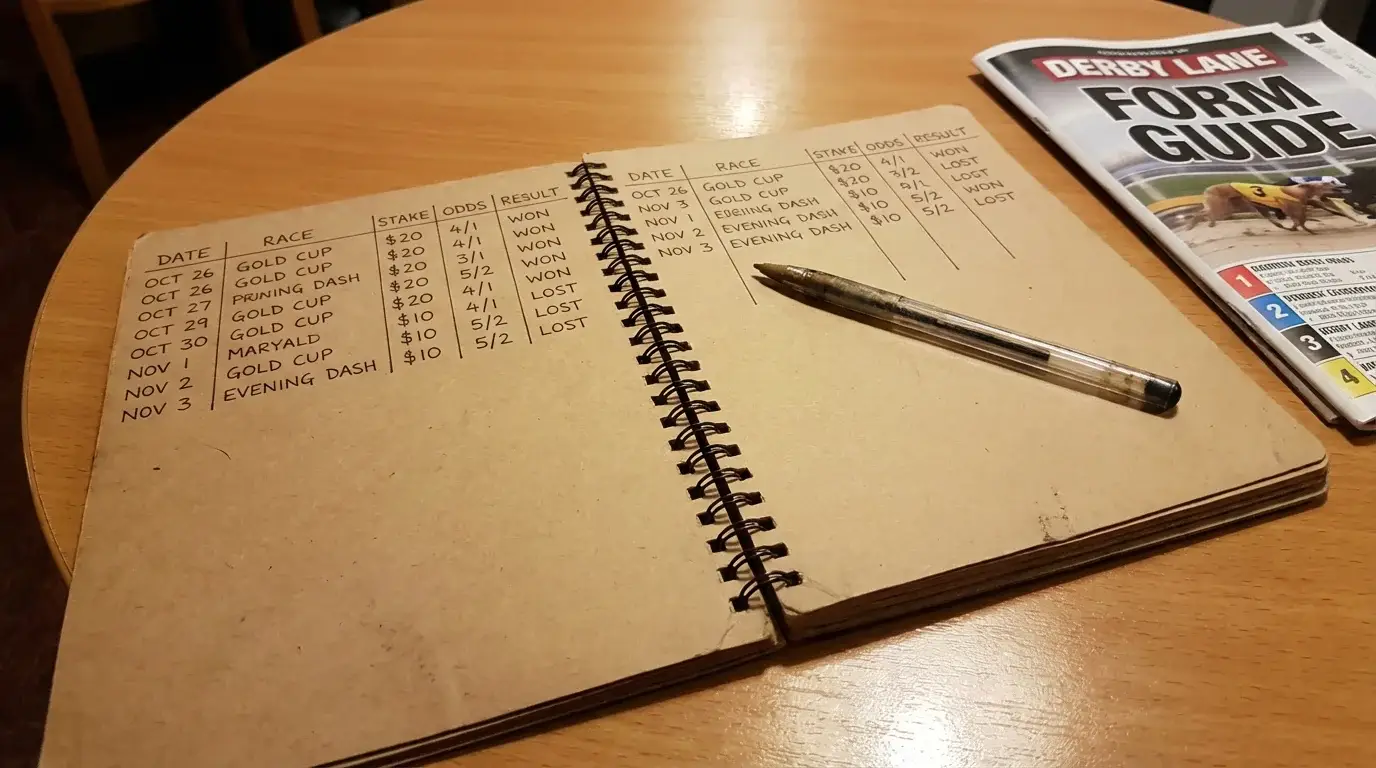
Without Bankroll Discipline, Strategy Is Decoration
You can pick winners and still go broke — bankroll management prevents that. The punter who backs three winners at 3/1 but loses twenty other bets at increasing stakes to chase the losses ends the week with less money than they started. The punter who backs the same three winners but at consistent, controlled stakes ends the week in profit. The difference isn’t analytical ability — it’s money management.
Bankroll management is the least glamorous and most important skill in betting. It doesn’t produce winners. It doesn’t find value. What it does is ensure that the winners you do find translate into actual profit, and that the inevitable losing streaks don’t destroy your ability to keep betting. Without it, even the best form analyst will eventually go bust. With it, even a modest analytical edge compounds into meaningful returns over time.
Manage your bets with help from harlowdogresults.
This guide covers the practical steps of setting up a dedicated bankroll, the main staking plans available to greyhound bettors, and the tracking discipline that turns betting from a series of isolated bets into a measurable, improvable process.
Setting Up a Dedicated Betting Bankroll
Separate your betting funds from your living expenses — no exceptions. This is the non-negotiable foundation of bankroll management. Your betting bankroll is a dedicated sum of money that you can afford to lose entirely without affecting your ability to pay bills, buy food or meet any other financial obligation.
Determining the size of your bankroll is a personal decision based on your financial situation, but the principle is simple: it should be an amount whose total loss would be disappointing but not harmful. For some punters, that’s £100. For others, it’s £500 or more. The amount matters less than the discipline of treating it as a distinct fund with clear boundaries.
Once you’ve established your bankroll, deposit it into your primary betting account (or split it across your active accounts if you use multiple bookmakers). Do not top it up from your general funds when it depletes. If the bankroll runs out, it runs out — and your options are to take a break, reassess your approach, and start a new bankroll when you’re ready. This hard boundary prevents the most dangerous behaviour in betting: dipping into money you can’t afford to lose because the last bet didn’t land.
A common approach is to allocate a monthly betting budget — a fixed amount transferred to your betting accounts at the start of each month. Any profits are either banked (withdrawn to a separate account) or rolled into the next month’s bankroll. Losses are absorbed within the monthly budget, and the budget doesn’t increase to chase them. This monthly cycle creates a natural rhythm of accountability that aligns well with the regular fixture schedule at tracks like Harlow.
Record your starting bankroll and review it weekly. Knowing your exact position — how much you started with, how much you’ve wagered, how much you’ve won and lost — is the data that informs every other decision. Without it, you’re guessing at your own performance, and guessing is what the bankroll is designed to prevent.
Staking Plans — Level Stakes, Percentage and Kelly Criterion
Level stakes keep it simple. Percentage staking adjusts to your balance. Kelly optimises growth. Each approach has strengths and weaknesses, and the right choice depends on your experience level, your bankroll size and your temperament.
Level stakes is the simplest plan: you bet the same amount on every selection, regardless of the odds or your confidence level. If your unit stake is £5, every bet is £5 — the 2/1 favourite and the 8/1 outsider both receive the same stake. The advantage is simplicity and emotional discipline: you never increase stakes after a loss and never decrease them after a win. The disadvantage is that it doesn’t account for the strength of your conviction or the value of the odds.
For most recreational greyhound bettors, level stakes is the recommended approach. It eliminates the psychological traps of variable staking — the temptation to bet more on “certainties” that aren’t, or to reduce stakes after a loss just when value might be greatest. A level-stakes plan at 1-2% of your bankroll per bet provides enough exposure to profit from winners while limiting the damage from losing runs.
Percentage staking adjusts the bet size to a fixed percentage of your current bankroll. If your bankroll is £500 and you stake 2% per bet, your initial stake is £10. If the bankroll grows to £600, the stake increases to £12. If it drops to £400, the stake falls to £8. The advantage is that your risk is proportional to your current position: you bet more when you’re winning and less when you’re losing, which protects the bankroll during drawdowns and capitalises on momentum during winning streaks.
The Kelly Criterion is a mathematical formula that calculates the optimal stake based on the perceived edge on each bet. The formula is: stake = (bp – q) / b, where b is the decimal odds minus 1, p is your estimated probability of winning, and q is your estimated probability of losing (1 – p). The Kelly approach maximises long-term bankroll growth in theory, but it requires accurate probability estimates — which are difficult to produce consistently — and it can recommend aggressively large stakes when perceived edges are high.
For greyhound bettors, a fractional Kelly approach (half-Kelly or quarter-Kelly) is more practical than full Kelly. It reduces the variance and the risk of ruin while still capturing the core benefit of proportional staking. However, any Kelly-based approach requires honest, calibrated probability estimates, and most punters overestimate their accuracy. If your probability estimates are consistently wrong, Kelly staking will accelerate your losses rather than your growth.
Tracking Your Bets — Spreadsheets, Apps and ROI
If you don’t track it, you can’t improve it. Every serious punter maintains a record of every bet placed — the selection, the odds, the stake, the result, the profit or loss, and ideally some additional context (grade, trap, conditions, reason for the selection).
A simple spreadsheet works for most punters. Record each bet on a new row with columns for date, track, race, selection, odds, stake, result and P/L. At the end of each week or month, calculate your total staked, total returned, net profit or loss, and return on investment (ROI). ROI — your net profit as a percentage of total staked — is the single most important metric for evaluating your betting performance over time.
Dedicated betting tracker apps exist for mobile and desktop, and some offer features beyond basic recording: automated import of bet histories from bookmaker accounts, visual dashboards showing performance trends, and filters that let you analyse your results by track, bet type, odds range or other variables. These tools add convenience but aren’t essential — a disciplined punter with a spreadsheet has everything they need.
The purpose of tracking isn’t just measurement — it’s diagnosis. When you review your records, look for patterns. Are you profitable at specific tracks but not others? Do your selections perform better at certain odds ranges? Are you losing money on accumulators while making it on singles? These patterns reveal where your analytical strengths lie and where your weaknesses are costing you. Without tracking, you’d never know — and you’d never improve.
Review your records monthly. Be honest with the data. If your ROI is negative after 200 or more bets, your approach needs adjustment — either in selection, staking or bet types. If it’s positive, identify what’s working and do more of it. The spreadsheet is your mirror. Use it.
Manage the Money — The Selections Will Follow
The best bettors aren’t the best pickers — they’re the best managers. Selection skill gets you an edge. Bankroll management keeps that edge alive long enough to produce results. The two are inseparable: one without the other is insufficient.
Stay safe with our responsible gambling guide.
Set your bankroll. Choose a staking plan and stick to it. Track every bet. Review monthly. Adjust when the data tells you to, not when emotion pushes you to. The dogs will run three times a week at Harlow and a dozen times a day across the UK. There will always be another race. There won’t always be another bankroll if you burn through this one. Protect the fund. The results will take care of themselves.
