
Harlow Stadium Track Guide: Distances, Traps & Meeting Schedule
 Available in US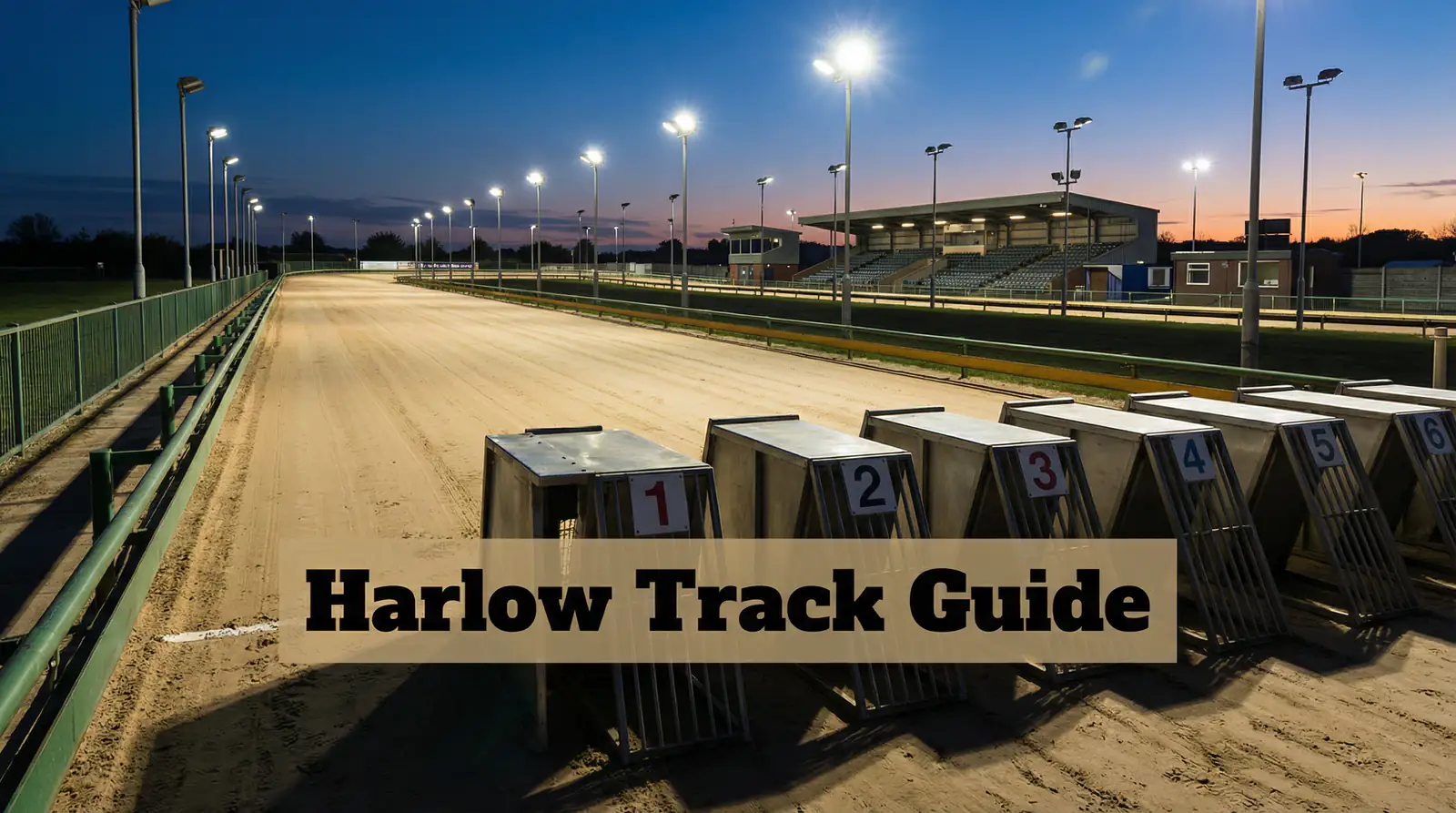
Harlow Stadium — A Punter’s Operating Manual
Knowing Harlow’s layout is the first bet you place — and it costs nothing. Every greyhound track in the UK has its own personality: a specific circumference, a set of distances, a surface that behaves differently in wet and dry conditions, and trap positions that favour certain running styles over others. Harlow Stadium in Essex is no exception. It’s a 334-metre oval with five race distances, six traps, and a sand-based surface that rewards punters who understand how the physical venue shapes every race run on it.
Most bettors approach greyhound racing dog-first. They look at form, pick a name, and place a bet. That approach ignores half the equation. A dog’s form is only meaningful in the context of the track it ran on — the distance, the trap drawn, the surface condition, and the bend geometry. A dog that excels over 415 metres at Romford might struggle over the same distance at Harlow because the track dimensions are different, the bends are wider, and the run to the first turn is longer. Track knowledge fills in the environmental context that form alone can’t provide.
This guide is designed as a reference for anyone who bets on Harlow regularly or plans to start. It covers the track’s history, its physical layout, how each of the five distances plays out, trap statistics broken down by distance, the weekly meeting schedule, and what to expect if you visit in person. The goal isn’t to make Harlow sound exotic — it’s to give you a working model of the venue so that every time you read a Harlow race card, you already know the terrain.
Get full race data at harlowdogresults.
Think of it as a scouting report. Professional bettors in horse racing study course profiles before they study the horses. The same logic applies here. The track is the constant; the dogs change every meeting. Know the constant first.
A Brief History of Harlow Greyhound Stadium
Harlow Stadium opened in March 1995 — young by track standards, but already steeped in racing pedigree. Located on Roydon Road in Harlow, Essex, the venue was purpose-built for greyhound racing at a time when many older tracks across the country were closing or being sold for redevelopment. That timing matters: unlike converted athletics grounds or repurposed stadiums, Harlow was designed from the ground up as a racing circuit, which means its dimensions, sightlines, and trap positions were optimised for greyhound competition rather than adapted from another sport.
The stadium operates under a GBGB licence — the Greyhound Board of Great Britain, which is the sport’s regulatory body responsible for licensing tracks, overseeing welfare standards, and maintaining the grading system. GBGB licensing means Harlow adheres to specific standards for track maintenance, veterinary presence, kennel facilities, and race integrity. For punters, a GBGB licence is a baseline assurance that the racing is regulated and the data — times, grades, form — is recorded to a consistent standard that can be meaningfully compared with other licensed venues.
Over the past three decades, Harlow has established itself as one of the busier tracks in the Essex and east London corridor, running three meetings per week and hosting both graded and open-race events. It sits alongside Romford as a regular destination for punters in the region, though its smaller circumference — 334 metres compared to Romford’s 350 — gives it a distinctly different racing character. Dogs that thrive on tight bends and fast straights at Romford face a different challenge at Harlow, where the track geometry produces different bend dynamics and straight lengths that reward sustained pace over raw acceleration.
Track Layout — 334 Metres, Six Traps, Five Distances
The oval measures 334 metres and races span from one-bend sprints to multi-lap marathons. Harlow’s circuit is a standard oval with two bends and two straights, but the dimensions place it in the mid-to-large category among UK tracks. For comparison, Romford measures 350 metres, Crayford sits at 334 metres, and Towcester — the largest active GBGB venue — measures 420 metres. Harlow’s 334-metre circumference means that a standard one-lap race covers more ground per circuit than at smaller tracks, which has direct implications for pace, stamina, and bend dynamics.
The running surface is sand-based, which is standard across GBGB tracks in England. Sand surfaces are maintained before each meeting — raked, levelled, and watered to a target consistency. The surface condition varies with weather: dry sand tends to be faster and firmer, while wet sand becomes heavier and slower, particularly on the bends where dogs dig in for traction. Harlow’s drainage characteristics mean the track recovers from rain reasonably quickly, but sustained wet weather can produce significantly different conditions from one meeting to the next. Punters who only check the form without checking the forecast are working with incomplete information.
The trap positions at Harlow are numbered 1 through 6, running from the inside rail to the outside. Trap 1, closest to the rail, gives a dog the shortest route to the first bend but also the most vulnerability to crowding from dogs breaking from wider traps. Trap 6, on the outside, provides a clean run into the bend with no traffic on the outside, but the dog covers more ground because of the wider racing line. The relative advantage of each trap shifts depending on the race distance, because the position of the starting boxes on the track changes with each trip. A trap 1 dog at 238 metres faces a different first-bend geometry than a trap 1 dog at 415 metres.
Five race distances are offered at Harlow: 238 metres, 415 metres, 592 metres, 769 metres, and 946 metres. Each distance has its own start position on the track, its own number of bends, and its own competitive profile. The shortest trip — 238 metres — starts on the back straight and involves a single bend before the finish line. The longest — 946 metres — requires nearly three full laps and tests a completely different set of physical attributes. Between those extremes, the 415-metre standard distance accounts for the majority of races on any given card and serves as the baseline for most form comparisons at the track.
Understanding which distance a race is run over is the first thing you should check on any Harlow race card, because the distance dictates everything else: which traps are advantageous, how much early pace matters, whether stamina is a factor, and how reliably the form from previous races at different distances transfers to today’s race. A dog’s form over 415 metres tells you almost nothing about its likely performance over 946 metres, and vice versa. The five distances at Harlow are functionally five different competitions held on the same piece of sand.
238m Sprint — One Bend, Pure Pace
The shortest trip at Harlow is a drag race — trap speed wins, form is secondary. At 238 metres, the dogs break from the traps on the back straight, negotiate a single bend, and sprint down the home straight to the finish. The race is over in roughly fourteen seconds. There is almost no time for a dog to recover from a slow start, work through traffic, or make up ground on the bends. The dog that gets out fastest and takes the bend in front almost invariably wins.
This makes the 238-metre sprint the most trap-dependent distance at Harlow. A fast-breaking dog in trap 1 has a structural advantage because it can hit the rail first and take the shortest route around the single bend. But a quick dog from trap 6 can also dominate by leading into the bend on the outside, provided it breaks level or ahead of the pack. What rarely works at this distance is coming from behind. If a dog misses the break by even a length, the race is usually over before it has a chance to make up the deficit. For betting purposes, sectional times and trap-break records matter far more at 238 metres than overall form or finishing positions from longer distances.
415m Standard — The Bread-and-Butter Distance
Most Harlow meetings are built around the 415-metre trip. It’s the standard distance — the one that appears most frequently on any card and the distance at which the grading system does most of its work. A 415-metre race involves roughly one and a quarter laps of the track, with two bends and enough straight running to allow dogs to express both early pace and finishing speed. It’s the closest thing greyhound racing has to a balanced test.
At 415 metres, early pace still matters, but it’s not the only factor. A dog that breaks slowly from the traps can recover if it has the speed to pick off rivals down the back straight or the stamina to sustain its effort through the final bend and up the home straight. Trap draw remains important — inside traps tend to have a slight statistical advantage over the standard distance — but the race is long enough for running style and race fitness to override a marginal trap disadvantage. Form analysis over 415 metres is the most reliable at Harlow because the sample size is largest and the competitive conditions are most consistent.
For punters, the 415-metre races are where bread-and-butter betting happens. The form is deep, the grading is well-calibrated, and the number of races per card means you can be selective — picking the two or three 415-metre events where your form reading gives you the clearest edge and passing on the rest. Trying to bet every race on the card is a bankroll hazard at any distance, but particularly wasteful at 415 metres where patience and selectivity produce better results than volume.
592m, 769m and 946m — Stamina Tests
The longer trips at Harlow separate the pure sprinters from dogs with genuine engine. At 592 metres, the race covers roughly one and three-quarter laps, adding an extra bend and a full additional straight to the standard trip. At 769 metres, the dogs are running over two laps with four bends. At 946 metres — the marathon distance — nearly three full laps are required, and the race lasts upwards of sixty seconds. These are fundamentally different contests from the sprint and standard distances, demanding a different physical profile and a different analytical approach.
Stamina becomes the dominant attribute as distance increases. A dog that blazes the first bend at 592 metres but fades through the second lap was never suited to the trip. Conversely, a dog with modest early pace that finishes strongly over 415 metres might be a revelation when stepped up to 592 or 769 metres, where its ability to sustain effort over a longer period becomes an asset rather than a limitation. Weight tends to correlate with stamina performance — heavier dogs often handle the longer distances better, particularly on heavy or rain-affected sand where lighter dogs tire more quickly.
Form from shorter distances is an unreliable guide for the longer trips. If a dog’s form line shows nothing but 415-metre runs, you’re extrapolating when you back it over 592 metres or beyond. Some dogs handle the step up; many don’t. Look for previous runs at the specific longer distance, and pay close attention to finishing positions and closing sectional times — a dog that finished fourth over 592 metres but was gaining ground through the final bend has more stayer potential than one that led for a lap and collapsed.
Trap Statistics by Distance at Harlow
Trap 6 wins 21% of all races at Harlow — but that headline hides distance-specific variation. Aggregate trap statistics for any track are useful as a starting point, but they flatten out the differences between distances, grades, and race types. A trap that dominates over 238-metre sprints might underperform over 415 metres, and a trap with a weak overall record might excel at the marathon distance. To use trap data properly at Harlow, you need to break the numbers down by distance and understand what’s driving the patterns.
Over the sprint distance, inside traps — particularly traps 1 and 2 — tend to show stronger win rates. The geometry explains this: with only one bend in the race, a dog on the inside takes the shortest path and has less ground to cover than a dog running wide from trap 5 or 6. At 238 metres, the advantage of the rail is amplified because there’s no second lap for wider-running dogs to make up the distance. If you’re betting on Harlow sprints and two dogs look evenly matched on form, the one drawn inside has a measurable structural advantage.
At the standard 415-metre distance, the trap bias narrows but doesn’t disappear. Traps 1 and 6 are generally the strongest performers, though the margin over middle traps is smaller than in sprints. Trap 1 benefits from rail access on the first bend, while trap 6 benefits from a clear outside run that avoids the crowding and bumping that middle traps — 3 and 4 in particular — are vulnerable to. The middle traps at 415 metres face the worst of both worlds: they don’t have the inside rail advantage, and they don’t have the outside clearance. Dogs drawn in traps 3 and 4 need either superior early pace to overcome the positional disadvantage or a racing style that copes well with traffic.
Over longer distances — 592 metres and beyond — the trap bias diminishes further. With multiple laps and multiple bends, the starting position becomes a smaller proportion of the total race and the impact of the initial trap draw is diluted by the sheer distance covered. A dog’s stamina, race fitness, and ability to negotiate crowded bends repeatedly matter more than where it started. That said, the first bend still has an outsized effect on race outcomes even at longer distances, because early trouble at the first bend can leave a dog lengths behind with a lot of ground to make up.
The practical takeaway is to weight trap data by distance, not in aggregate. If you’re assessing a 238-metre race, inside traps carry a genuine edge and should influence your selections. If you’re looking at a 592-metre event, the trap draw is one factor among several, and overweighting it at the expense of stamina form would be a mistake. The trap statistics at Harlow tell a clear story — but only when you read them at the right resolution.
One caveat on all trap data: statistics describe tendencies across hundreds or thousands of races. They don’t predict individual outcomes. A trap with a 22% win rate still loses 78% of the time. Trap bias is a tiebreaker, not a selection method. It narrows the field and adjusts your confidence in marginal cases, but it should never be the sole reason for backing a dog. The form, the grade, the dog’s running style, and the pace dynamics of the specific race all carry more weight than the trap number. Use the data to refine your analysis, not to replace it.
Meeting Days, Race Times and How to Plan Your Betting
Harlow runs Wednesday, Friday and Sunday — three chances per week to apply what you know. The meeting schedule is one of the busiest among Essex tracks, and the consistency of the calendar is an advantage for regular punters. You know when the racing happens, you can plan your form study around fixed dates, and you can build a rhythm of analysis that compounds knowledge over time. Punters who bet sporadically at Harlow are always starting from scratch; those who follow the schedule systematically develop a familiarity with the current dog population, the active trainers, and the track conditions that casual visitors simply don’t have.
Meeting sessions at Harlow rotate between morning, afternoon, and evening start times. Morning meetings typically begin around 10:30 AM, afternoon sessions around 2:00 PM, and evening meetings at approximately 7:30 PM. The specific session for each day varies and is published in advance through the GBGB website and through racing portals like Sporting Life. Checking the scheduled session time is worth doing before you commit to betting, because the time of day affects conditions. Evening meetings in winter are run under floodlights on colder sand, which can produce slightly different going conditions compared to afternoon meetings on the same day.
A typical Harlow card features between ten and fourteen races, each with six runners. That’s a full programme by UK greyhound standards and offers enough variety to be selective. You don’t need to bet every race — and you shouldn’t. The meetings with the most betting value are often the midweek cards, where the fields are graded solidly and the public attention is lower than on Sunday mornings. Lower public attention means softer markets and occasionally wider odds on runners that the weekend crowd would have spotted. Sunday meetings attract more casual footfall, both trackside and online, and the prices tend to reflect that broader participation.
Planning your betting around the schedule also means planning your bankroll. Three meetings per week adds up. If you’re betting four races per meeting at an average stake of five pounds, that’s sixty pounds a week before returns. Knowing the schedule forces you to budget — and budgeting is the first discipline of profitable betting. Set your weekly allocation before the first meeting, not during it.
Visiting Harlow Stadium — What to Expect Trackside
If you’re making the trip to Roydon Road, here’s what the venue offers beyond the racing. Harlow Stadium is a working greyhound track, not a destination resort — set your expectations accordingly. It has the facilities you need for a night at the dogs: covered viewing areas, on-site catering, a licensed bar, and Tote betting windows alongside access to bookmaker pitches. The atmosphere on a busy Sunday is lively without being chaotic, and the compact layout means you’re never far from the action.
The venue is accessible by car, with parking available on site. By public transport, Harlow Town railway station is the nearest stop, served by Greater Anglia from London Liverpool Street. The station is a short taxi ride from the stadium, though walking isn’t impractical if the weather cooperates. For those driving, the M11 provides the most direct route from central London and the surrounding areas. Arriving early is advisable for Sunday meetings, when the car park fills more quickly and trackside positions near the finish line get claimed early.
Trackside, the standard admission gives you access to the general viewing areas and the Tote facilities. Some meetings offer restaurant or hospitality packages that include a meal, a reserved table with a view of the track, and a race programme. These are popular for group outings and special occasions — the dogs have always been as much a social event as a betting one. For the serious punter, though, the general admission area is all you need. Get a decent sightline to the first bend and the finish, keep your phone handy for live form data, and focus on the races rather than the hospitality. The dogs don’t care whether you’re eating steak or standing in the cold.
Track Knowledge Is the Edge Nobody Talks About
Most punters bet the dog. Smart punters bet the track — then check which dog suits it. That distinction sounds subtle, but it reshapes the entire analytical process. When you know that Harlow’s 238-metre sprint is a one-bend race where trap speed dominates, you stop looking at overall form and start looking at sectional times and break records. When you know that inside traps have a measurable advantage at the standard distance, you adjust your confidence in a dog drawn in trap 1 versus the same dog drawn in trap 4. When you know the track runs three times a week, you plan your study and your bankroll around that rhythm instead of betting impulsively whenever you happen to notice a race is on.
Track knowledge is the edge that compounds. Every meeting you watch at Harlow adds to your understanding of how the surface behaves, which trainers are running their dogs in the right grades, and how the trap draw plays out at each distance. That accumulated understanding can’t be replicated by reading a single form line fifteen minutes before a race. It’s the product of attention over time, and it separates the punters who treat Harlow as a regular investment from those who treat it as an occasional gamble.
Understand racing odds with our racing-odds-explained.
Nothing in this guide replaces form analysis. A dog’s recent performances, its grading trajectory, its running style, and its times all matter. But form is only half the picture. The other half is the stage the form was produced on. A dog’s time of 24.40 over 415 metres at Harlow means something specific — and different — from the same time at Romford. A trap 6 draw at Harlow sprints carries different weight from trap 6 at Harlow’s marathon distance. The track is the constant that gives form its context, and without that context, you’re reading the data with one eye closed.
Learn the track. Then learn the dogs. In that order.
