
Responsible Gambling Guide for Greyhound Bettors
 Available in US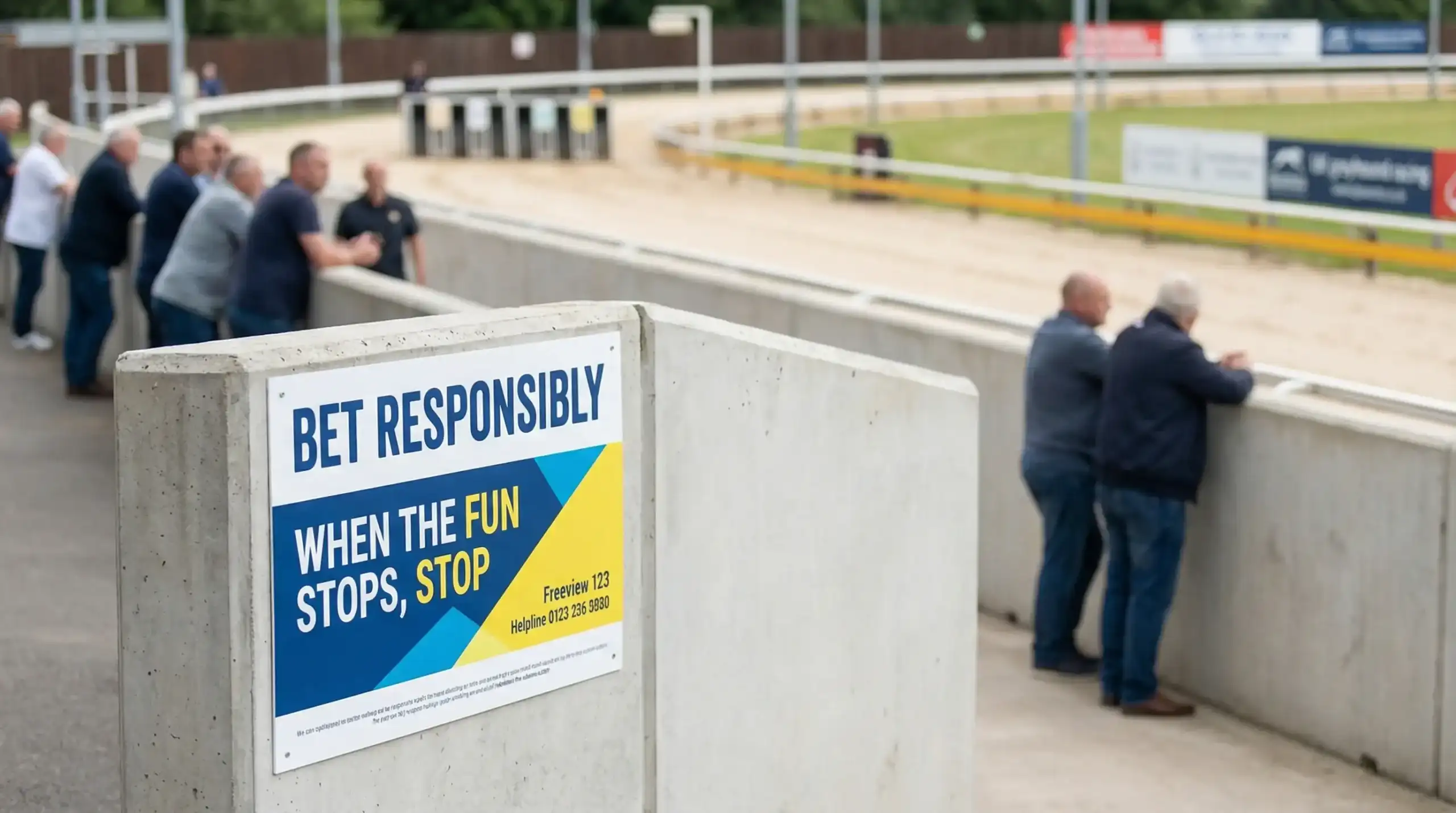
Betting Should Be Enjoyable — These Tools Keep It That Way
Responsible gambling isn’t a disclaimer section — it’s the infrastructure that makes everything else work. Every strategy, every form analysis, every staking plan discussed in this series assumes that you’re betting within your means, with money you can afford to lose, and with full control over your decisions. When any of those conditions breaks down, the analytical framework becomes irrelevant. The best form reader in the world can’t overcome the damage caused by chasing losses with money earmarked for rent.
The UK has one of the most comprehensive responsible gambling frameworks in the world, enforced by the UK Gambling Commission and supported by a network of free, confidential support services. Every UKGC-licensed bookmaker is required to offer tools that help you manage your betting — deposit limits, time-outs, self-exclusion, activity statements. These tools exist because the industry and the regulator recognise that gambling carries real risks, and that managing those risks is a shared responsibility between the operator and the individual.
Bet safely — start at harlowdogresults.
This guide explains the tools available, describes the warning signs that suggest gambling may be causing harm, and provides direct information about where to get help. It’s written for greyhound bettors specifically, but the principles apply to all forms of gambling.
Self-Exclusion, Deposit Limits and Time-Outs
Every UKGC-licensed bookmaker offers these tools — here’s how to use them proactively rather than reactively.
Deposit limits are the most practical first-line tool for maintaining control. You set a maximum amount you can deposit into your account within a chosen period — daily, weekly or monthly. Once the limit is reached, no further deposits are accepted until the period resets. The beauty of deposit limits is that you set them when you’re thinking clearly, and they hold you to that decision even when emotions or impulse might push you to deposit more. Set your deposit limit before you place your first bet, and review it quarterly to ensure it still reflects your financial situation.
Reducing a deposit limit takes effect immediately. Increasing it typically requires a cooling-off period of 24 to 72 hours, depending on the operator. This asymmetry is deliberate — it’s designed to prevent impulsive increases during a losing session. If you find yourself repeatedly hitting your deposit limit or frustrated by the cooling-off period when trying to increase it, that’s a signal worth paying attention to.
Time-outs temporarily suspend your account. You can typically choose periods of 24 hours, 48 hours, 7 days or 30 days. During a time-out, you cannot place bets, deposit funds or access the betting interface. Time-outs are useful when you recognise that you need a break — after a bad run of results, during a stressful period in your personal life, or simply when betting stops feeling enjoyable. They’re a circuit breaker, not a punishment.
Self-exclusion is the strongest level of intervention. When you self-exclude, your account is closed for a minimum period — usually six months to five years, depending on the operator and the scheme. During self-exclusion, you cannot open a new account with that operator. GamStop is a free national scheme that allows you to self-exclude from all UKGC-licensed operators simultaneously. Registration takes a few minutes and is effective across all participating sites.
Activity statements provide an objective record of your betting history. Most bookmakers offer detailed transaction histories showing deposits, withdrawals, bets placed, wins, losses and net position over any period. Reviewing this data monthly gives you a factual picture of your betting behaviour — one that might differ from your subjective impression. If you think you’re roughly breaking even but your activity statement shows a consistent net loss, the data is telling you something important.
Recognising Problem Gambling Behaviours
Chasing losses, hiding bets, and betting beyond your budget are signals, not strategies. Problem gambling often develops gradually — a pattern of behaviour that starts as occasional overreach and escalates into a cycle that the individual feels unable to control. Recognising the early signs, honestly and without self-deception, is the most effective form of prevention.
Chasing losses is the most common warning sign. After a losing session, the impulse to place another bet to recover the loss is natural — but acting on that impulse repeatedly is a pattern that almost always deepens the loss rather than reversing it. If you find yourself increasing stakes, betting on races you haven’t analysed, or depositing additional funds specifically to chase a deficit, the behaviour has moved beyond disciplined betting.
Betting with money you can’t afford to lose is another clear signal. If your betting funds come from savings, credit, borrowed money or funds allocated to essential expenses, the activity has exceeded your financial capacity. Betting should only ever involve discretionary income — money that, if lost entirely, would not affect your ability to meet financial obligations.
Concealment is a particularly telling sign. If you’re hiding the amount you bet, the frequency of your betting, or your losses from family members, partners or friends, there’s usually a reason — and the reason is rarely good. Concealment indicates that you know, on some level, that the behaviour would cause concern if others were aware of it. That awareness is worth acting on.
Other warning signs include: spending more time betting than you intend, feeling restless or irritable when not betting, neglecting work or personal responsibilities because of betting, and repeatedly promising yourself to cut back without following through. None of these signs in isolation is definitive, but a pattern of several is worth taking seriously.
Where to Get Help — UK Support Organisations
GamCare, GambleAware and the National Gambling Helpline provide free, confidential support to anyone affected by gambling. These organisations are funded by the gambling industry through regulatory levies and operate independently of individual operators.
The National Gambling Helpline, run by GamCare, is available on 0808 8020 133, 24 hours a day, seven days a week. The service offers phone-based support, including advice, counselling referrals and practical help with managing gambling-related issues. It’s free to call and completely confidential.
GamCare also offers online chat support through its website, as well as structured counselling programmes — both one-to-one and group — for individuals experiencing gambling-related harm. These services are available across the UK and can be accessed through the GamCare website.
GambleAware is the UK’s leading charity for gambling harm reduction. Its website provides educational resources, self-assessment tools and a directory of local support services. If you’re not sure whether your gambling is a problem, the GambleAware self-assessment is a private, non-judgmental starting point that takes a few minutes to complete.
GamStop, as mentioned above, provides free self-exclusion from all UKGC-licensed gambling websites. Registration is voluntary and can be done online in minutes. GamStop is a practical step for anyone who has decided to take a break from online gambling and wants to ensure that impulse doesn’t override that decision.
The Best Bet Is the One You Can Afford
Long-term enjoyment of greyhound betting depends on staying in control. The analytical skills, the form reading, the staking plans and the track knowledge discussed throughout this series all assume a foundation of responsible, controlled betting. Without that foundation, everything else is built on sand.
Review our legal information.
Set your limits. Use the tools. Review your activity honestly. And if anything about your betting stops feeling like a choice and starts feeling like a compulsion, seek support. The help is free, the conversations are confidential, and reaching out is a sign of strength, not failure. Greyhound betting at its best is an engaging, intellectually rewarding activity. Keeping it that way is your most important responsibility as a punter.
