How to Analyse Greyhound Form for Betting
 Available in US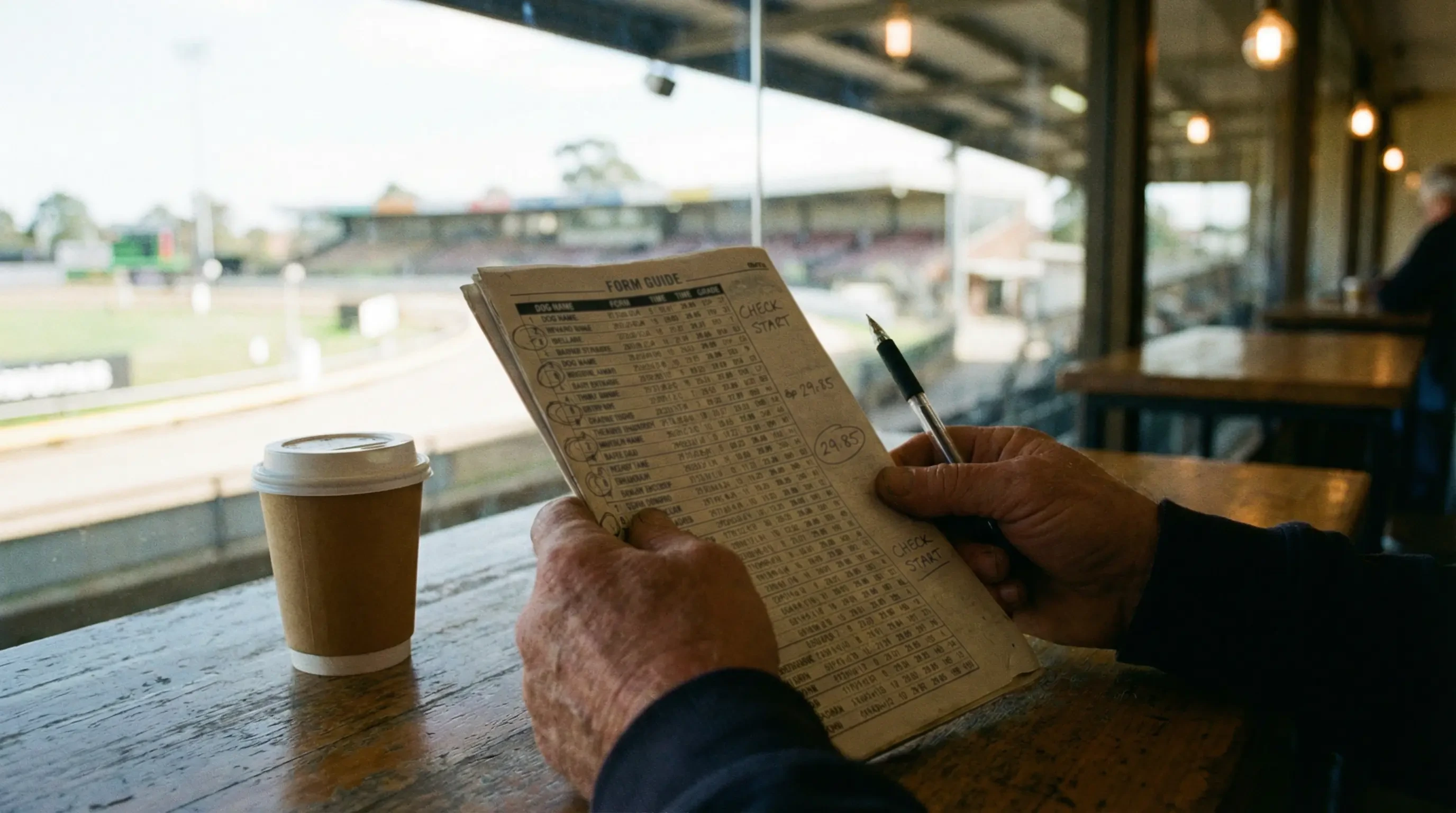
Form Analysis Is the Core Skill of Profitable Punting
Every profitable greyhound bet starts with form — and ends with value. Form analysis is the process of examining a dog’s recent racing history and current circumstances to estimate its chance of winning or placing in tonight’s race. The estimate doesn’t need to be precise to the decimal point. It needs to be accurate enough that, when compared to the odds on offer, it identifies bets where the price exceeds the probability. That gap between your assessed probability and the bookmaker’s odds is where profit lives.
Good form analysis isn’t about knowing everything. It’s about knowing the right things and weighting them correctly. A dog’s last finishing position is one data point. Its trap draw tonight is another. The grade it’s running in, the distance, the conditions, the trainer’s recent record — each factor adds a layer to the picture. The skill is in combining those layers into a coherent assessment, not in memorising every statistic.
See the latest form data at harlowdogresults.
This guide covers the core form factors that every greyhound punter should consider, explains how to recognise form patterns and cycles, and shows how to cross-reference historical form with tonight’s specific race conditions.
Key Form Factors — Recency, Class, Distance, Draw
Four factors interact in every form assessment. They don’t carry equal weight in every race, but they’re always relevant, and ignoring any of them leaves a gap in your analysis.
Recency is the first filter. A dog’s most recent two or three races are more informative than anything further back. Greyhound form is volatile — dogs can improve or decline quickly based on fitness, injury, confidence and the natural aging curve. A dog that won three races in a row six weeks ago but hasn’t run since may not reproduce that form tonight. Conversely, a dog that finished poorly in its last two outings after a strong run might be due a bounce back if the poor results were caused by bad luck rather than declining ability.
Examine the race comments alongside the finishing positions. A dog that finished fifth after being “bumped first bend, checked second” ran a fundamentally different race from one that finished fifth after “always behind, never in contention.” The first dog was impeded and might have placed with a clear run. The second was outclassed. The form figure is the same; the information is completely different.
Class — the grade of the races in the dog’s recent form — determines the context for interpreting those results. A third-place finish in an A2 race tells you more than a win in A7. When a dog drops in class from A3 to A5, its recent A3 form may be better than anything the A5 field has produced. When a dog steps up from A6 to A4, its winning form at A6 might not be fast enough to compete at the higher level. Always note the grade of each previous race and adjust your expectations for the grade of tonight’s race.
Distance matters because dogs have distance preferences just as horse racing runners do. A dog that excels at the standard 415-metre trip may struggle at 592 metres, where stamina becomes a factor. Conversely, a stayer that looks moderate over 415 metres might transform over 769 metres. When a dog is running at a distance it hasn’t attempted before — or hasn’t attempted recently — the form from its usual trip is only partially relevant. You’re making a judgement about aptitude based on breeding, running style and physical profile rather than hard evidence.
The trap draw is the final core factor, and it’s the one that changes race by race. A dog might have excellent recent form — but all of that form might come from Trap 1, and tonight it’s drawn in Trap 5. A railer from Trap 5 faces a different tactical challenge: it needs to cross traffic to reach the rail, which creates risk of interference and costs ground. The same form, from a different trap, produces a different probability. Cross-referencing the dog’s running style with tonight’s trap draw is the step that most casual punters skip — and the step that most consistently separates good analysis from lazy analysis.
Identifying Form Patterns and Cycles
Dogs go in and out of form — recognising the pattern gives you timing. Greyhounds are physical animals with finite peak periods, and their performance follows cycles that attentive punters can track.
A typical form cycle starts with a dog returning from a break in moderate condition. Its first race back might produce a below-par performance as it regains race fitness. Over the next two or three outings, its times improve, its sectionals tighten, and its finishing positions move closer to the front. At peak form, the dog produces its best times and wins or places consistently. Eventually, the peak passes — fatigue, minor niggles or loss of sharpness cause a gradual decline. The trainer may then give the dog a rest, and the cycle resets.
Spotting where a dog sits in this cycle is one of the most valuable skills in form analysis. A dog whose sectionals have improved across three consecutive runs is approaching peak form. A dog whose sectionals have drifted over the same period is moving away from it. Market prices often lag behind the cycle: a dog on an improving trend may still be priced based on its below-par early returns, and a dog past its peak may still carry the confidence of its recent wins.
Seasonal patterns exist too. Some dogs perform better in cooler weather; others prefer summer conditions. Dogs that race frequently (every four to five days) can burn out faster than those given longer gaps between outings. Noting how each dog responds to its racing frequency helps you identify runners who are being over-raced — a common cause of form decline that trainers don’t always address quickly enough.
Cross-Referencing Form with Tonight’s Trap Draw
Good form from Trap 1 doesn’t guarantee good form from Trap 5. This principle is so simple it’s almost insulting to state — and yet it’s violated constantly, even by experienced punters who should know better.
The trap draw changes the tactical equation for every runner. A railer drawn inside has a clear path to the rail and a short route to the first bend. The same railer drawn in the middle must navigate other dogs to reach its preferred line. The same railer drawn outside has virtually no chance of reaching the rail before the bend without significant interference.
When you assess form, note the trap the dog ran from in each previous race. If a dog’s best recent result came from Trap 2 and it’s drawn Trap 6 tonight, that result is less relevant to your assessment than a more moderate result from a middle or outside trap. The ideal data point is a recent run from a similar trap — or at least from the same side of the track — to the one the dog occupies tonight.
Running-style indicators on the race card (“r” for railer, “m” for middle, “w” for wide) tell you the dog’s preference, and the trap draw tells you whether that preference is accommodated. The combination of these two pieces of information is more predictive than either one alone. A wide runner drawn wide with recent form from outside traps is in its comfort zone. A wide runner drawn inside with all its form from outside traps is in unfamiliar territory.
Form Is the Starting Line — Not the Finish Line
Analysis gets you in the race. Discipline gets you home. Form analysis identifies the selections; value assessment determines whether the price justifies the bet; and staking discipline ensures you survive the losing runs that are inevitable even with strong analysis. All three steps matter, and form analysis without the other two is academic exercise rather than profitable betting.
Also learn what early pace.
Develop a consistent process: check the form, note the grade, assess the distance, evaluate the draw, compare with the price. Do it for every race you consider betting on, and do it the same way every time. Over hundreds of bets, a consistent analytical process produces better results than occasional bursts of brilliance followed by periods of guesswork. Form analysis is the foundation. Build on it with discipline, and the returns follow.
