Virtual Greyhound Racing Betting Guide
 Available in US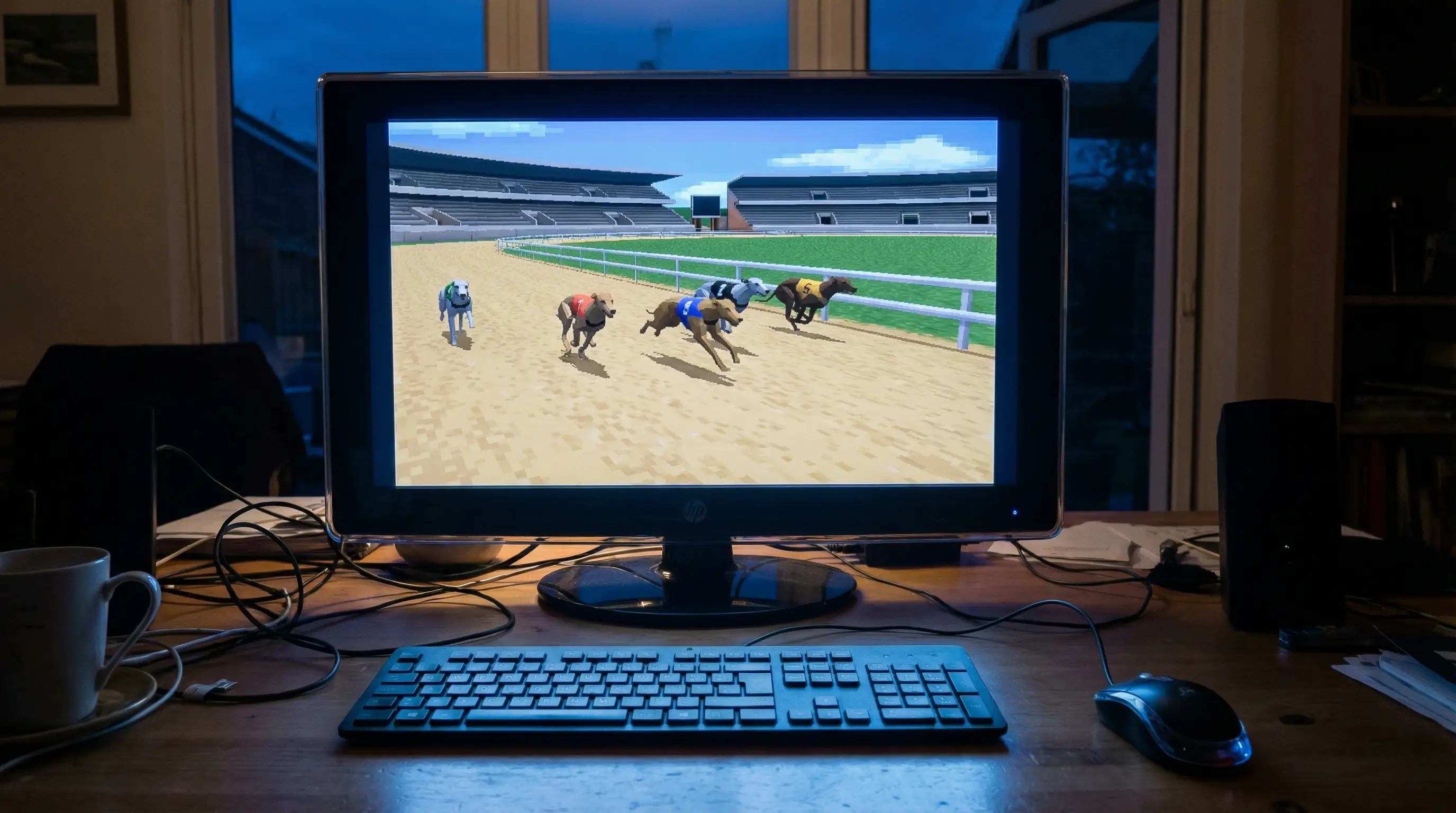
Virtual Greyhounds — Not Real Dogs, Not Real Form
Virtual greyhound racing uses random number generators, not live dogs. That sentence should be the starting point and the finishing point of any serious conversation about virtual greyhound betting, because it defines everything that follows. There are no traps to analyse, no sectional times to compare, no trainers to track and no weather to account for. The dogs on your screen are animated characters whose performance is determined entirely by software — an algorithm producing random outcomes designed to mimic the appearance of real racing.
Virtual greyhound events are available around the clock on most major UK bookmakers, running every two to three minutes with no breaks and no off-season. They fill the gaps between live meetings, providing continuous betting opportunities for punters who want action at any hour. The appeal is obvious: there’s always a race about to start, the interface looks familiar, and the bet types are the same as real racing.
The danger is equally obvious. Because virtual racing looks like real racing, it’s tempting to apply real-racing analysis to it — studying the form figures displayed on the virtual race card, noting which virtual dog “won” its last virtual outing, trying to identify patterns. None of that works. The outcomes are random, and any apparent pattern in past results is coincidence, not form. This guide explains how virtual greyhound racing operates, what betting markets are available, and why treating it differently from real racing protects your bankroll.
Get more tips at harlowdogresults.
How Virtual Greyhound Races Work
Inspired Entertainment and other providers create simulated races every two to three minutes, generating a continuous stream of events for bookmakers to offer. The technology combines random number generation with sophisticated animation to produce a visual product that closely resembles live coverage of a real meeting.
Each virtual race features a field of runners — typically six, matching the real greyhound format — each assigned a name, a trap number and a set of displayed form figures. The race card may show the virtual dog’s recent results, a notional “rating” and even simulated odds that fluctuate before the virtual off. All of this is generated by the software. The names are fictional, the form is fabricated, and the ratings are part of the presentation layer rather than indicators of genuine ability.
The outcome of each race is determined by a random number generator certified by independent testing agencies. The RNG produces a result that is then rendered as animation — the virtual dogs running around a virtual track. The race you watch on screen is a visualisation of a pre-calculated result presented in real time. Nothing that happens during the animation changes the outcome.
The RNG is calibrated to produce results within specific probability ranges that create a realistic distribution. Favourites win at roughly the frequency their displayed odds imply. Outsiders win occasionally. Forecasts and tricasts hit at rates that approximate their theoretical probability. The system is designed to feel like real racing — and to maintain a built-in margin for the operator, just as a real bookmaker’s overround does.
The intervals between races are short by design. A new virtual greyhound event starts every two to three minutes, meaning you can place dozens of bets per hour if you choose. This rapid cycle is one of the key risk factors: the sheer volume of betting opportunities can lead to much higher spending per session than a real meeting, where races are spaced fifteen to seventeen minutes apart.
Providers like Inspired Entertainment supply their virtual racing products to multiple bookmakers simultaneously. The same virtual race may be available across several sites, though the odds can vary slightly between operators. Some bookmakers brand their virtual greyhound products with specific names or themes, but the underlying technology and RNG mechanism is broadly similar across providers.
Betting Markets for Virtual Greyhounds
Win, forecast and tricast are available — but the analysis framework is entirely different. Or rather, there is no analysis framework, because the inputs that drive real greyhound betting — form, trap bias, conditions, trainer data — simply don’t exist in virtual racing.
The betting markets mirror real greyhound racing closely. You can bet on a virtual dog to win, place an each-way bet, construct a straight or reverse forecast, or attempt a tricast. The mechanics of each bet type are identical to their real-racing equivalents: a forecast requires the first two in order, a tricast requires the first three, and each-way pays a fraction of the odds for a place finish.
What changes is how you approach the decision. In real racing, you select a dog based on form, trap draw, conditions and value assessment. In virtual racing, every selection is essentially random from the punter’s perspective. The displayed odds reflect the RNG’s probability weighting for each virtual runner, and the bookmaker’s margin is built into those odds just as it is in real racing. There is no information advantage available to any bettor, because the outcomes are not influenced by any analysable factor.
Some punters claim to have found patterns in virtual results — a certain trap winning more often, a particular virtual dog on a “hot streak.” These patterns are statistical noise. In a random system with a large number of events, short-term clusters are inevitable. Trap 3 might win four of the last six virtual races, but that tells you nothing about the next race. The RNG has no memory of past results.
The one genuine decision available to you in virtual greyhound betting is the same as in any other form of gambling with a fixed house edge: bankroll management. You can choose how much to stake, how frequently to bet, and when to stop. That’s the extent of your control. Everything else is determined by software.
Virtual vs Real Greyhound Betting — Key Differences
Form, conditions and trap bias don’t apply — virtual outcomes are pure probability. This is the fundamental difference, and every other difference flows from it.
In real greyhound racing, skilled bettors gain an edge through analysis. They study form, track conditions, sectional times, trainer statistics and trap draws. That analysis identifies situations where the bookmaker’s odds underestimate a dog’s true chance of winning, creating positive expected value. Over hundreds of bets, that edge compounds into profit. The skill is real, and the returns reward it.
In virtual racing, no analysis produces an edge because the outcomes are randomly generated. The bookmaker’s odds already reflect the exact probability distribution of the RNG. There is no “true probability” to uncover through research because the displayed probability is the true probability. The house margin, embedded in the odds, ensures that the expected return on any virtual bet is negative over time. No amount of study changes this.
The pace of betting is another critical difference. A real greyhound meeting at Harlow features ten to fourteen races over three hours. A virtual session can offer twenty or thirty races in the same period. The rapid cycle encourages higher volumes of betting and makes it harder to maintain staking discipline. At a real meeting, the fifteen-minute gap between races provides natural cooling-off time. In virtual racing, the next event starts before you’ve fully processed the last one.
Emotional engagement differs too. Watching a real race involves genuine uncertainty and the satisfaction of seeing your analysis validated — or the useful frustration of identifying where your assessment went wrong. Virtual racing produces a simulacrum of that experience, but there’s nothing to learn from the result. A virtual loss doesn’t teach you anything because there was nothing you could have done differently. A virtual win doesn’t validate your method because there was no method — just chance.
The regulatory framework is identical, which is important. Virtual greyhound racing is subject to the same UKGC licensing requirements as real racing. The RNG must be tested and certified, the odds must be fair within the declared parameters, and the operator must provide responsible gambling tools. You’re protected from manipulation, but not from the mathematical reality that the house holds an edge on every bet.
Virtual Racing Is Gambling, Not Handicapping
There’s no edge to find in virtual results — treat it as entertainment. This isn’t a dismissal of virtual racing; it’s an accurate description of what it is. Like a slot machine or a roulette wheel, virtual greyhound racing is a game of chance with a fixed house margin. The presentation is more engaging than spinning reels — you watch animated dogs race around a track, which is inherently more interesting — but the underlying mathematics are the same.
If you enjoy virtual greyhound racing as a form of entertainment, there’s nothing wrong with that. Set a budget, treat it as the cost of entertainment (like buying a cinema ticket), and stop when the budget is gone. Don’t chase losses, don’t increase stakes to recover, and don’t convince yourself that you’ve found a system that beats the RNG. Systems don’t work against random outcomes with a negative expected value. They never have and never will.
Read our responsible gambling guide.
The real risk of virtual racing for greyhound punters is that it can blur the line between skill-based and chance-based betting. If you spend an evening betting on virtual dogs between real meetings, you might start applying the same casual approach to your real-racing bets — skipping the form study, placing bets on impulse, treating the next race at Harlow the same way you treated the last virtual event. Keep the two activities separate in your mind and in your bankroll. Real racing rewards analysis. Virtual racing rewards nothing but luck. Knowing the difference is the whole game.
