Greyhound Forecast Bet Explained: Straight and Reverse
 Available in US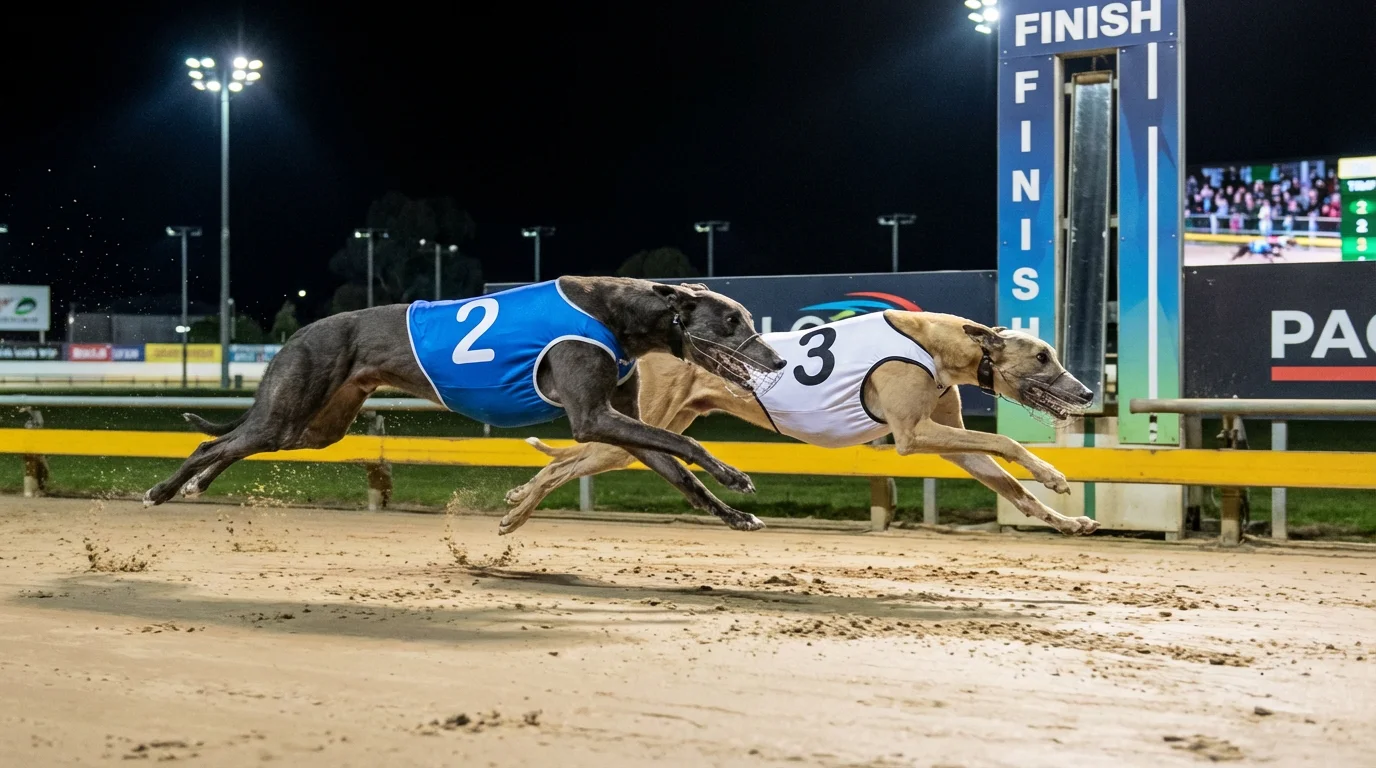
Forecast Bets — Predicting the First Two Home
A forecast bet asks you to name the first two finishers — and the payout rewards the difficulty. While a win bet requires you to identify only the dog that crosses the line first, a forecast demands that you get the top two right. In exchange for that additional precision, forecast dividends are significantly larger than win returns, sometimes dramatically so when outsiders fill the places.
Forecasts are one of the most popular bet types in UK greyhound racing, partly because the six-dog fields make the proposition more achievable than in horse racing. With only six runners, there are 30 possible first-and-second combinations. Compare that to a twelve-horse field, where the combinations run into the hundreds, and greyhound forecasts start to look almost manageable. Almost.
The challenge, of course, is that “manageable” still means getting two predictions right in the correct sequence. Even experienced form analysts find forecasts harder than win bets simply because the second variable introduces uncertainty that multiplies with the first. Getting the winner right is one thing. Getting the runner-up right as well — from a field of five remaining dogs, any of which might place depending on the break, the bend, and a dozen other factors — is a different level of difficulty.
Find more at harlowdogresults.
This guide covers the three main types of forecast bets — straight, reverse and combination — and explains when each one offers genuine value over a simple win wager.
Straight Forecast — Exact Order Required
In a straight forecast, order is everything. You name two dogs: one to finish first and one to finish second, in that specific sequence. If Trap 3 wins and Trap 5 finishes second, your straight forecast on 3-5 pays. If Trap 5 wins and Trap 3 finishes second — the right dogs but the wrong way round — you lose. There’s no consolation for getting half the bet right.
The rigidity of the straight forecast is what creates its value. Because you must predict the exact finishing order of two dogs, the bookmaker’s risk is lower (the bet is less likely to land), which means the return when it does land is proportionally larger. Straight forecast dividends in greyhound racing routinely pay between £10 and £50 to a £1 stake, and in races with surprise results, the returns can climb much higher.
How the dividend is calculated depends on whether you’re betting at the track or online. On-course, straight forecasts are typically settled through the tote pool. The total money wagered on forecasts in that race is pooled together, the operator takes a percentage, and the remainder is distributed among winning tickets. The dividend reflects how much money was staked on the specific combination that came in — a popular combination pays less, an unpopular one pays more.
Online bookmakers often offer fixed-odds forecasts rather than pool-based ones. The price is calculated from the individual win odds of the two dogs, adjusted by a formula that the bookmaker applies. Fixed-odds forecasts give you certainty about the return before the race, whereas pool-based returns are only known after settlement. In general, fixed-odds forecasts tend to offer slightly lower returns than the tote pool for longshot combinations, but slightly better returns for shorter-priced combinations. Comparing both options, where available, is worthwhile.
The key tactical question with a straight forecast is confidence in the order. If you’re fairly sure which dog wins but less certain about the runner-up, a straight forecast is risky. If you have a strong opinion on both positions — say you believe the quick trapper from Trap 1 will lead throughout and the strong finisher from Trap 6 will run into second — the straight forecast captures that view at a generous price.
Reverse Forecast — Either Order, Double Stake
A reverse forecast covers both permutations at twice the cost. You select two dogs, and the bet wins if they finish first and second in either order. Effectively, you’re placing two straight forecasts: one on Dog A first and Dog B second, and one on Dog B first and Dog A second.
The advantage is obvious — you remove the problem of guessing the exact order, which is the hardest part of a straight forecast. The disadvantage is equally clear: your stake is doubled. A £1 reverse forecast costs £2 because it contains two lines. If the combination lands, only one of your two straight forecasts wins, so your return is the dividend of the winning line, not both.
Reverse forecasts are most useful when you’ve identified two dogs that you believe will dominate a race but you’re uncertain which one will win. This situation arises regularly in greyhound racing, particularly in graded races where two dogs have markedly better form than the rest of the field. In a race with two standout runners and four clearly weaker opponents, a reverse forecast is a natural bet structure. You’re confident in the pair but agnostic about the order.
The value calculation for a reverse forecast depends on how different the two possible dividends are. If both dogs are similarly priced (both around 3/1, for instance), the two straight forecast dividends will be close together, meaning it doesn’t matter much which way round the result falls. But if one dog is 2/1 and the other is 8/1, the two dividends will be very different. The permutation with the longshot winning and the favourite placing will pay substantially more than the reverse. In that case, you might consider whether a straight forecast on the more valuable permutation alone — rather than a reverse covering both — makes more sense for your stake.
Reverse forecasts are settled at the pool dividend when bet on-course and at fixed odds when bet online. The same comparison principles apply as with straight forecasts: check the fixed-odds returns against likely pool returns if you have access to both.
Combination Forecast — More Dogs, More Lines
Select three or more dogs and the combination generates every possible first-two pairing. A combination forecast on three dogs produces six lines (3 x 2 permutations). On four dogs, it produces twelve lines (4 x 3). On five dogs, it generates twenty lines. Your unit stake multiplies by the number of lines, so a £1 combination forecast on four dogs costs £12.
Combination forecasts are the broadest form of forecast betting and are suited to races where you’ve identified a group of contenders but can’t narrow it down to just two. If you think three dogs all have realistic winning chances and any two of them could fill the first two spots, a combination on all three covers every possible finishing order.
The downside is cost. Twelve lines at £1 each is £12 committed to a single race, and the return needs to be large enough to justify that outlay. In practice, combination forecasts work best when at least one of your selected dogs is at bigger odds, because the winning dividend needs to exceed the total stake by a meaningful margin. Three short-priced dogs in a combination forecast might land frequently, but the returns often barely cover the stake.
There’s a middle ground that some punters use effectively: a combination forecast on three dogs, with one dog designated as the banker (the one you expect to win) and two others as the place selections. Instead of a full combination (six lines), you bet two straight forecasts with the banker in first place and each of the other two in second (two lines, costing £2). This approach costs less and still covers the scenarios you consider most likely, though it sacrifices the permutations where the banker finishes second.
When Forecasts Offer Value Over Win Bets
Forecasts are strongest when you can identify two likely protagonists in a weak field. The ideal forecast race has a clear structure: two dogs stand out on form, and the remaining four are either outclassed or poorly drawn. In that scenario, the probability of the top two finishing first and second is relatively high, but the forecast dividend still pays a premium over a simple win bet because it requires both positions to be correct.
The worst time to bet forecasts is in open, competitive races where all six dogs have a genuine chance. In a race without clear form separation, the number of plausible first-and-second combinations expands dramatically, and the probability of any specific forecast landing drops. These are the races where win bets or each-way bets are more appropriate.
Distance matters too. Sprint races at 238 metres are often decided by trap speed and the break, which means the dog with the quickest sectional from a favourable trap has a strong win chance — but the second-place finisher is harder to predict because the race is so short that small margins determine the order. At longer distances, form and running style have more time to assert themselves, which makes the forecast outcome more forecastable.
Read about greyhound tricast bets.
If you’re a disciplined punter who already identifies winners at a reasonable strike rate, adding forecasts selectively — in races with clear two-dog structures — can boost your return without dramatically increasing your risk. The key word is selectively. Forecasting every race on a twelve-race card is a guaranteed way to shrink your bankroll. Forecasting two or three races with the right profile is a tool that deserves space in your approach.
