Greyhound Racing Odds Explained: Fractional, Decimal & Payout Maths
Best Greyhound Betting Sites – Bet on Greyhounds in 2026
Loading...
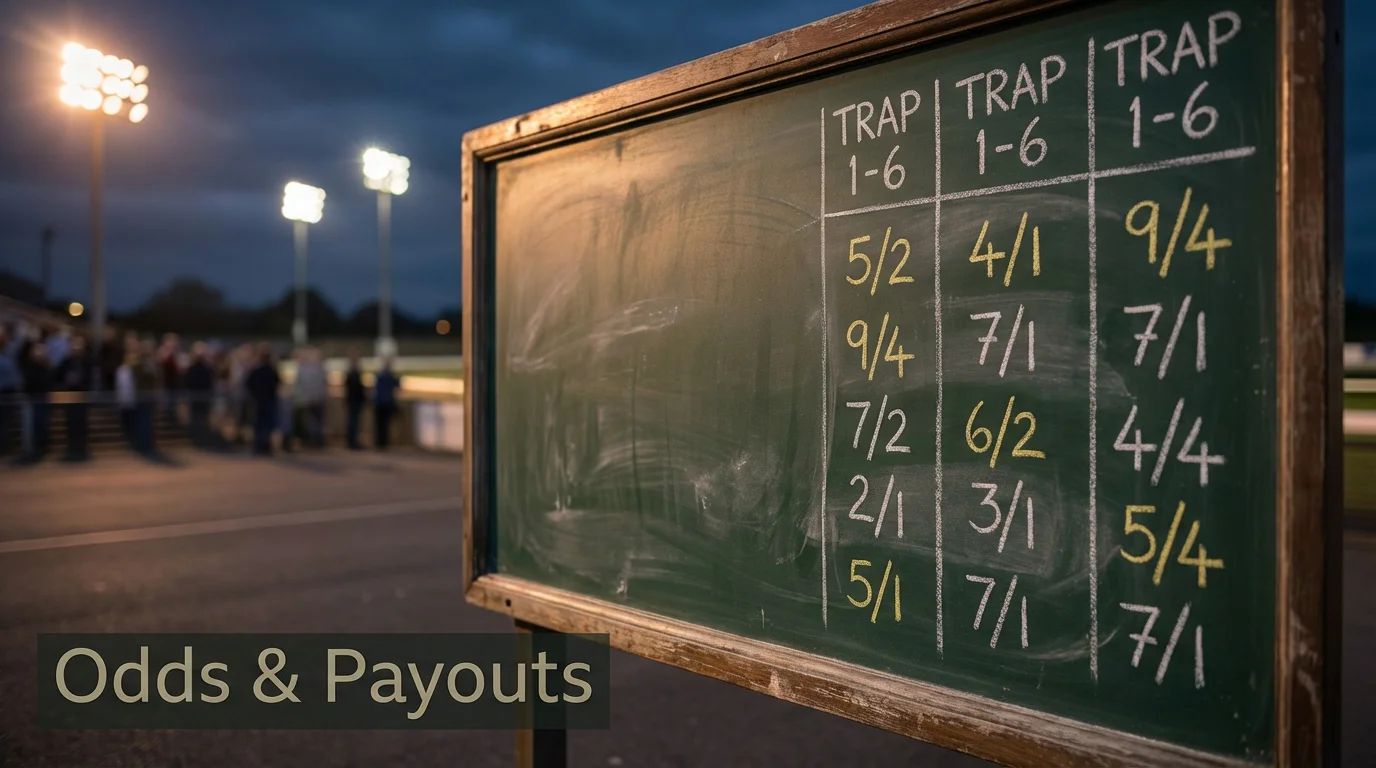
Odds Are a Language — Learn to Speak It
You can’t spot a value bet if you can’t calculate what the odds actually mean. Odds are the foundation of every betting decision, yet a surprising number of regular punters treat them as little more than a price tag — higher numbers mean bigger payouts, lower numbers mean safer bets. That’s the equivalent of shopping by looking at price labels without checking what’s in the box. Odds encode specific information: the bookmaker’s implied probability, your potential return, and — if you know how to read them — the margin the bookmaker has built into the market.
In UK greyhound racing, odds are displayed in two primary formats: fractional and decimal. Both express the same relationship between stake and return, but they do it differently, and the format you’re comfortable with affects how quickly you can assess a bet’s value. If you only understand one format, you’re limiting yourself to platforms and markets that use it. If you understand both, every bookmaker, every exchange, and every market becomes accessible.
Beyond the formats, odds connect directly to probability — and probability is where the real analytical work happens. Every set of odds implies that the bookmaker believes an outcome has a certain chance of occurring. If you can convert odds to implied probability, you can compare the bookmaker’s view with your own assessment. When those views diverge — when you believe a dog’s chance is higher than the odds suggest — you’ve found potential value. That single skill, applied consistently, is the difference between recreational punting and strategic betting.
This guide covers both odds formats, the conversion between them, how payouts are calculated across different bet types, the distinction between starting price and fixed odds, and how the overround — the bookmaker’s built-in margin — affects every price on the board. The arithmetic is not advanced. The advantage it gives you is.
Fractional Odds — The Traditional UK Format
Fractional odds are everywhere in UK greyhound racing — and they confuse more punters than they should. Displayed as two numbers separated by a slash — 5/1, 7/2, 11/4, 4/6 — fractional odds tell you the profit you’ll receive relative to your stake. The number on the left is the profit, the number on the right is the stake. At 5/1, for every £1 you stake, you receive £5 profit if the bet wins. At 7/2, every £2 staked returns £7 profit. You also get your original stake back on top of the profit, which is worth remembering when comparing with decimal odds.
Where confusion creeps in is with odds shorter than even money. An odds-on price like 4/6 means you need to stake £6 to win £4 profit. The return includes your £6 stake, so you receive £10 total — but the profit portion is less than what you risked. Odds-on bets are appropriate when a dog has a high probability of winning, but the risk-reward ratio is compressed. A 4/6 shot needs to win more than 60% of the time to be profitable at that price, and few greyhounds achieve that strike rate consistently.
To calculate total return from fractional odds, divide the first number by the second, multiply by your stake, and add the stake back. At 11/4 with a £4 stake: 11 divided by 4 equals 2.75, multiplied by £4 equals £11 profit, plus your £4 stake gives a total return of £15. The arithmetic becomes second nature with practice, but in the early stages it’s worth working through it deliberately rather than relying on the bookmaker’s payout display, because understanding the calculation trains you to think in probabilities rather than just prices.
Common fractional odds you’ll encounter at UK tracks include evens (1/1), 6/4, 2/1, 5/2, 3/1, 7/2, 4/1, 5/1, 6/1, 8/1, and 10/1. Each step up the ladder represents a larger potential return and a lower implied probability. The favourites in a typical six-dog race are usually priced between 6/4 and 3/1, while outsiders sit at 6/1 and above. Knowing where your selection sits on this scale — and what that position implies about its win probability — is the first step in assessing whether the price represents value.
Decimal Odds and How They Compare
Decimal odds show total return per unit staked — simpler maths, same outcome. Where fractional odds separate profit from stake, decimal odds combine them into a single number. A dog at 6.00 in decimal means you receive £6 total for every £1 staked, including your original stake. The equivalent fractional price is 5/1. A dog at 2.50 in decimal returns £2.50 per £1 — equivalent to 6/4 fractional. The decimal number is always the fractional profit divided by the fractional stake, plus one.
The practical advantage of decimal odds is speed of comparison. When assessing multiple runners in a race, decimal prices let you rank them instantly — 4.00 pays more than 3.50, which pays more than 2.80. No mental division required. For this reason, betting exchanges like Betfair default to decimal, and most European bookmakers use decimal as their primary format. UK-facing bookmakers typically offer both and let you switch in the settings. If you’re not already using decimal odds for your analytical work, switching is worth the brief adjustment period.
Converting between formats is arithmetic, not art. To convert fractional to decimal, divide the numerator by the denominator and add one. 7/2 becomes 3.5 + 1 = 4.50. To convert decimal to fractional, subtract one and express the result as a fraction. 3.25 becomes 2.25, which is 9/4 fractional. The conversion gets messier with non-standard fractions, but for the prices you’ll encounter most often at UK greyhound meetings, a simple mental conversion table covers the common cases: evens = 2.00, 6/4 = 2.50, 2/1 = 3.00, 5/2 = 3.50, 3/1 = 4.00, 4/1 = 5.00, 5/1 = 6.00, 10/1 = 11.00.
One thing decimal odds make immediately obvious is the magnitude of odds-on prices. A 1/2 shot in fractional sounds like a reasonable bet — the dog is the clear favourite. In decimal, that’s 1.50 — which means for every pound you risk, you get back just fifty pence in profit. Seeing 1.50 written as a single number makes the risk-reward compression harder to ignore, which is precisely why decimal can be a more honest format for self-assessment.
Converting Odds to Implied Probability
Every set of odds contains a hidden number — the bookmaker’s view of probability. This is the most important concept in betting mathematics, and it’s the one most casual punters never engage with. Odds are not random numbers. They are expressions of probability, adjusted by the bookmaker’s margin. When a dog is priced at 3/1 (4.00 decimal), the bookmaker is implying that the dog has approximately a 25% chance of winning. Whether that number is accurate is where your analysis comes in.
The formula for converting decimal odds to implied probability is simple: divide 1 by the decimal odds, then multiply by 100 to get a percentage. At 4.00 decimal: 1 divided by 4.00 equals 0.25, which is 25%. At 2.50 decimal: 1 divided by 2.50 equals 0.40, which is 40%. At 6.00: 1 divided by 6.00 equals approximately 0.167, or 16.7%. For fractional odds, the formula is: denominator divided by (numerator plus denominator), multiplied by 100. At 3/1: 1 divided by (3 + 1) equals 0.25, or 25%. Same result, different route.
Once you can convert odds to implied probability, you can compare the bookmaker’s assessment with your own. Suppose you’ve studied a race card and concluded that a dog has roughly a 30% chance of winning. The bookmaker has priced it at 5/1, which implies a 16.7% chance. The gap between your 30% assessment and the bookmaker’s 16.7% implied probability is substantial — if your analysis is sound, this is a strong value bet. Now suppose a different dog is priced at 2/1, implying a 33% chance, and you estimate its true probability at 25%. That’s a negative-value bet — the bookmaker is offering you less return than the risk justifies.
The practical discipline is to estimate your probability before you see the odds, or at least to form a preliminary view that isn’t anchored by the bookmaker’s price. If you look at the odds first, your probability estimate will be unconsciously pulled towards the implied number — a well-documented cognitive bias known as anchoring. Working in the other direction — analysis first, odds second — preserves the independence of your assessment and gives the comparison genuine meaning.
Implied probability also reveals how the bookmaker sees the race as a whole. If you add up the implied probabilities of all six dogs, you’ll get a number higher than 100%. That excess is the overround — the bookmaker’s built-in margin — and it tells you how much of the total market is being skimmed before anyone gets paid. More on that shortly. For now, the key takeaway is that every price on the board is a probability statement, and learning to read it as such transforms odds from a payout display into an analytical tool.
How Greyhound Payouts Are Calculated
Payout calculation is arithmetic, not gambling — and it’s the foundation of value assessment. Before you place any bet, you should know exactly what you stand to receive if it wins and what you lose if it doesn’t. This sounds obvious, but the number of punters who place bets without checking the return until after the race is higher than you’d expect. Knowing your payout in advance is not just good housekeeping — it’s essential for assessing whether a bet offers enough return to justify the risk.
For a simple win bet, the payout is your stake multiplied by the decimal odds. A £5 bet at 4.00 decimal (3/1 fractional) returns £20 total — £15 profit plus your £5 stake. If you’re working in fractional odds, multiply your stake by the fractional value and add the stake back. £5 at 3/1: £5 times 3 equals £15 profit, plus £5 stake equals £20 total. The numbers are identical regardless of format. Where it gets more involved is with compound bet types — each-way bets, forecasts, tricasts, and accumulators — where the payout structure is layered.
Accumulator payouts compound each leg’s return into the next. A £2 double on two dogs at 3/1 and 2/1 calculates as follows: the first leg’s return is £2 times 4.00 (decimal) = £8. That £8 becomes the stake on the second leg at 3.00 (decimal), returning £24. Total return: £24 from a £2 stake. In fractional terms, you can multiply the fractional values: 3/1 times 2/1 equals 6/1, so £2 at the combined odds of 6/1 produces £12 profit plus £2 stake, which is £14. Wait — that doesn’t match the £24. The discrepancy is because accumulator odds in decimal compound the full returns including stake, while the fractional shortcut omits it. The correct fractional compound is (3+1) times (2+1) = 12, minus 1 = 11/1, giving £22 profit + £2 = £24. Always verify with the decimal method to avoid this common error.
For place bets, the payout uses a fraction of the win odds. In standard greyhound racing, place terms are typically one-quarter of the win odds for first or second place in a six-runner field. A £5 place bet at 4/1 pays at one-quarter of 4/1, which is 1/1 (evens), returning £10 total. The place fraction varies by bookmaker and sometimes by promotion, so checking the terms before placing the bet is essential — assuming standard terms when the bookmaker is offering enhanced terms, or vice versa, will produce an inaccurate payout expectation.
Each-Way Payout Mechanics
Each-way adds a place component — and the place fraction changes the maths significantly. An each-way bet is two separate bets: one on the win, one on the place. Both carry the same stake, so a £5 each-way bet costs £10 total. If the dog wins, you collect on both components. If it places second, you collect on the place component only. If it finishes third or worse, you lose both stakes.
The win component pays at full odds. The place component pays at a fraction — typically one-quarter of the odds for greyhound racing with six runners. At 6/1 each-way with a £5 unit stake: the win part returns £30 profit + £5 stake = £35. The place part returns £7.50 profit (6/1 at one-quarter = 6/4, so £5 at 6/4 = £7.50) + £5 stake = £12.50. Total return if the dog wins: £47.50 from a £10 outlay. If the dog places second: you collect £12.50 from the place bet and lose the £5 win bet, for a net position of +£2.50 on the total £10 staked. Understanding this net position at different odds levels tells you at what price each-way betting starts to protect you adequately — and at what price the place return barely dents the overall loss.
Forecast and Tricast Dividends
Forecast payouts are pool-based at the track but fixed-odds online — that distinction matters. At the track, forecast and tricast dividends are calculated from the Tote pool after the race. The total pool is divided among winning tickets after the operator’s deduction (typically around 20-28%). This means the payout is unknown until the race finishes and the pool is settled. Two identical bets on the same forecast can return different amounts at different tracks or on different days, depending on pool size and the number of winning tickets.
Online bookmakers increasingly offer fixed-odds forecasts and tricasts, where the payout is derived from a formula based on the starting prices of the dogs involved — the Computer Straight Forecast for forecasts and the Computer Tricast for tricasts. These calculated dividends are standardised, which means the payout is more predictable, though not known at the time of the bet because it depends on the SP. The CSF formula takes the prices of the first and second dog and produces a dividend that reflects the difficulty of the prediction. In general, forecast dividends increase when both dogs are at longer odds (a less predictable outcome) and decrease when one or both are short-priced (a more predictable outcome). Understanding this relationship helps you assess whether a forecast offers enough potential return to justify the increased difficulty compared to a simple win bet.
Starting Price vs Fixed Odds — Which to Choose
Taking a price early or waiting for SP is a strategic decision, not a preference. When you place a bet at a fixed price — say 4/1 — that’s the price locked in regardless of what happens to the market between now and the race start. Starting price, or SP, is the price at the moment the traps open, which fluctuates based on market movements and the weight of money from other punters. Choosing between the two affects your return, sometimes significantly.
The case for taking a fixed price is strongest when you believe the dog’s odds will shorten before the race. If you spot value at 5/1 and the market agrees, the SP might come in to 3/1 — and you’ve locked in the better number. This is particularly relevant for dogs that are likely to attract late money: class droppers, trainer patterns, or runners returning from a break that the broader market hasn’t yet assessed. Taking the price early preserves the value before the crowd catches up.
The case for SP is less about gaining an advantage and more about avoiding a specific risk. If a dog drifts in the market — its odds lengthen from 4/1 to 6/1 — taking SP gives you the longer price, which implies the market found reasons to be less confident. Sometimes that drift reflects genuine information (the dog’s looked poor in the parade, for instance), and SP protects you from being locked into a shorter price on a dog whose chances have diminished. Some bookmakers offer Best Odds Guaranteed on greyhound racing, which pays you whichever is higher — your fixed price or the SP. Where BOG is available, it removes the dilemma entirely and is always the optimal choice.
The Overround — How Bookmakers Build Their Margin
Add up the implied probabilities of all six dogs — it’ll exceed 100%. That gap is the bookmaker’s edge. The overround, sometimes called the vig or the juice, is the mathematical mechanism by which bookmakers guarantee themselves a margin regardless of the race outcome. In a perfectly fair market, the implied probabilities of all outcomes would sum to exactly 100%. In reality, they always sum to more — typically 115% to 130% for greyhound racing markets — and that excess is the bookmaker’s structural profit.
Here’s a worked example. Suppose a six-dog race is priced as follows in decimal: 3.00, 4.00, 5.00, 7.00, 9.00, 12.00. Converting each to implied probability: 33.3%, 25.0%, 20.0%, 14.3%, 11.1%, 8.3%. Sum: 112.0%. The overround is 12%. This means the bookmaker has priced the market as though there are 112 chances out of 100, which is mathematically impossible — but commercially essential. That 12% excess is distributed across all six prices, making each one slightly shorter than it would be in a fair market.
The practical implication is that every price you see on the board is slightly worse than the true probability. A dog whose genuine chance of winning is 25% might be priced at 3/1 (implied 25%) in a fair market, but at 5/2 (implied 28.6%) in a market with a 12% overround. The bookmaker has shaved the price just enough to build in a margin. Over thousands of bets, that margin compounds — which is why bookmakers profit consistently and the average punter loses.
Understanding the overround doesn’t eliminate it, but it changes how you shop. Different bookmakers apply different margins to the same race. One might run a 115% book while another runs a 125% book on the same meeting. The lower-margin bookmaker offers better prices across the board, which means more value for the punter. Comparing odds across multiple bookmakers — a practice called line shopping — is one of the simplest, most reliable ways to improve your long-term returns without changing anything about your selection process. You’re backing the same dog; you’re just getting paid more for it.
The overround also varies by race. Featured or graded races at popular meetings tend to have tighter books (lower overround) because more money flows through the market and competition between bookmakers is fiercer. Low-profile midweek races may carry fatter margins. If you’re selecting between two races of equal analytical clarity, the one with the tighter book offers better value by default. This is a marginal gain, but marginal gains compound — and in a pursuit where the house has a structural edge, accumulating small advantages is how you fight back.
When You Understand the Odds, You Stop Betting Blind
Odds literacy is the dividing line between punters who play and punters who compete. Everything covered in this guide — fractional and decimal formats, implied probability, payout mechanics, SP versus fixed odds, and the overround — is basic mathematical infrastructure. None of it is advanced. None of it requires a calculator beyond what your phone already provides. And yet, the majority of regular greyhound punters operate without a working knowledge of these fundamentals, which is why they consistently leave money on the table.
When you understand odds, you stop reacting to prices and start evaluating them. A dog at 5/1 is no longer just “a nice price” — it’s a statement that the bookmaker assigns the dog roughly a 16.7% chance of winning, and you either agree with that assessment or you don’t. A dog at evens is no longer “the favourite” — it’s a proposition that the dog wins 50% of the time, minus the overround, and your form analysis either supports that probability or it falls short. Every price on the board becomes a question: is this accurate?
Asking that question consistently, honestly, and before you place the bet is the entire practice of value betting. The odds tell you what the market thinks. Your analysis tells you what you think. When the gap between those two assessments is wide enough, and when your analysis is sound enough to trust, you have a bet. When it isn’t, you have the discipline to wait. That discipline — informed by mathematical literacy and applied through a consistent process — is what separates strategic punters from the rest of the trackside crowd.