What Is Early Pace in Greyhound Racing?
Best Greyhound Betting Sites – Bet on Greyhounds in 2026
Loading...
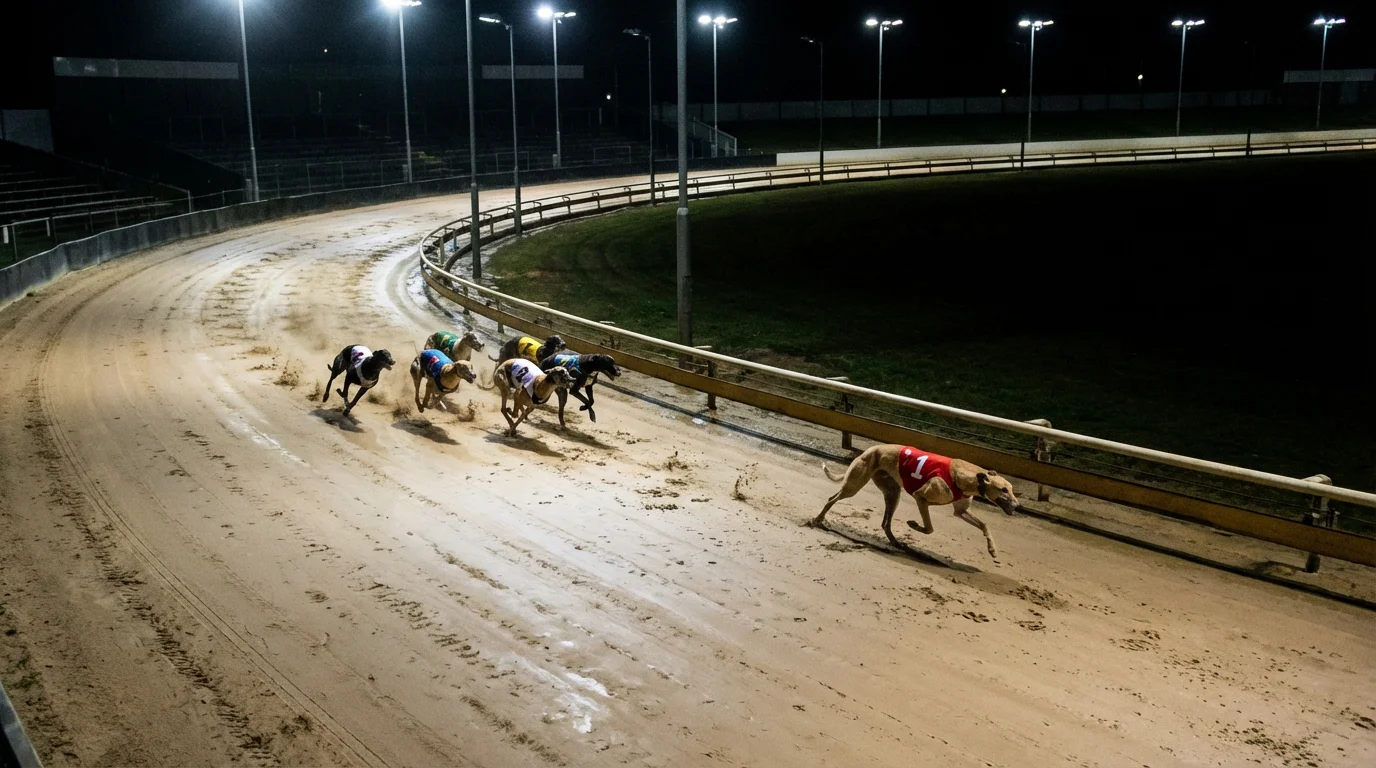
Early Pace Defines How Most Greyhound Races Are Won
At most UK tracks, the dog that leads into the first bend wins more often than not. That’s not a hunch or a trend — it’s a structural feature of the sport. Greyhound races are short, the field is small, and the track is tight enough that once a dog establishes position on the first bend, passing it requires either an error by the leader or exceptional late speed from the chaser. Neither happens often enough to override the fundamental advantage of leading early.
This makes early pace the single most predictive variable in greyhound racing. Not sectional times alone, though they’re part of it. Not the trap draw alone, though that influences where a dog ends up at the bend. Early pace is the combination of these factors — how quickly a dog leaves the traps, how fast it covers the opening straight, and where it sits when the field funnels into the first turn. A dog that does all three well is rarely beaten. A dog that does none of them is rarely in contention.
For punters, understanding early pace is the foundation of competent race analysis. It’s the first filter you should apply to any race card, and in many cases it’s sufficient on its own to identify the likely shape of the race. Where it gets interesting — and profitable — is in the races where the pace dynamics create conflict. Two dogs with fast early pace drawn next to each other. A quick trapper in an outside box that needs to cross traffic. A slow beginner from Trap 1 that’s fast enough to win if it gets a clear run but vulnerable to being swallowed at the bend. These are the scenarios where pace analysis separates the sharp punters from the rest.
Measuring Early Pace — Splits, Box Speed and First Bend Position
Early pace combines trap speed, straight-line velocity and bend positioning. Each component is measurable, and together they form a complete picture of how a dog starts its race.
Trap speed — sometimes called box speed — refers to how quickly a dog reacts to the traps opening and begins its run. Some dogs are explosive from the boxes, hitting full stride within two or three paces. Others are sluggish, taking a stride or two longer to find their rhythm. This difference, measured in fractions of a second, translates into lengths by the time the field reaches the first bend. Race cards don’t always publish a dedicated box-speed figure, but the sectional time captures the effect: a dog with a consistently fast split is, by definition, a quick trapper.
Straight-line velocity covers the distance between the traps and the first bend. At most tracks, this is the home straight, and the dogs run it in a roughly linear formation before the track curves. The sectional time — measured from traps to the winning line on the first pass — quantifies this phase. A dog with a 3.15 sectional at Harlow is covering the opening straight significantly faster than one clocking 3.30. Over approximately 100 to 120 metres, that gap represents multiple lengths.
First-bend position is the outcome of trap speed and straight-line velocity, modified by the trap draw and the dog’s running line. A dog can post a quick sectional but still be third at the bend if it runs wide from an outside trap and has to travel further to reach its preferred line. Conversely, a dog with a moderate sectional from Trap 1 might lead at the bend simply because it has the shortest route to the rail.
Results services publish first-bend positions alongside finishing positions and sectional times. The notation varies — some use numbers (1st, 2nd, 3rd at the bend), others use descriptive codes — but the information is there. When you see a dog listed as “led first bend” or “first at bend” in its recent form, that’s the data point you’re looking for. A dog that consistently leads at the first bend from favourable traps is the pace setter, and in greyhound racing, the pace setter has a statistical advantage that dwarfs almost every other factor.
To build a reliable early-pace assessment, you need at least three recent runs at the same track. Sectionals and bend positions from different tracks aren’t directly comparable because the distances differ and the track geometry varies. Use same-track data wherever possible, and weight the most recent runs more heavily — a dog’s current sharpness matters more than what it did six runs ago.
Pace Bias by Track — Where It Matters Most
Harlow, Crayford, Romford — smaller circuits amplify the first-bend advantage because the bends arrive sooner and the track is tighter. On a small circuit with sharp turns, a dog that leads into the first bend has less distance to protect its position. The trailing dogs have less straight running to build speed and close the gap, and the tight bends make it harder to pass on the outside without losing ground.
At Harlow specifically, the track’s 334-metre circumference and relatively short home straight mean that the first bend comes quickly after the traps. Dogs have limited time and distance to establish position, which places a premium on raw trap speed. A dog that’s half a length behind at the bend might need the entire backstraight to close that gap — and at Harlow, the backstraight isn’t long enough for many dogs to do it.
Larger tracks present a different picture. At Towcester, which is one of the biggest circuits in the UK, the bends are more sweeping and the straights are longer. Early pace still matters — the leader at the first bend still wins a disproportionate share of races — but the advantage is less pronounced because trailing dogs have more room and more time to make up ground. The pace bias exists at every track, but its magnitude varies, and that variation should influence how heavily you weight early pace in your analysis.
Track-level data confirms these differences. At tight circuits, the correlation between first-bend position and final finishing position is strong — often above 60% for the leader. At larger tracks, it drops, though it remains the single strongest predictor. If you’re primarily betting at Harlow or similar small tracks, early pace should be your primary analytical tool. If you’re betting across a range of tracks, adjust the weight you give it according to the circuit characteristics.
Distance within a track also modifies pace bias. Sprint races at 238 metres are almost entirely determined by early pace because the race is too short for anything else to matter. Standard-distance races at 415 metres are heavily influenced by early pace but allow some scope for late runners. Marathon races at 946 metres dilute the first-bend advantage because the race duration gives stamina and tactical versatility time to come into play. When assessing pace, always consider the distance as well as the track.
Using Early Pace in Your Selections
Identify the likely leader, then ask: can anything stop them? That’s the core question, and answering it is the basis of most sound greyhound selections.
Start with the race card. List each dog’s average sectional and first-bend position from their last three runs at the track. Identify the dog — or dogs — with the quickest sectionals. Check their trap draws. A fast dog in a suitable trap (railers inside, wide runners outside) is likely to lead. A fast dog in an unsuitable trap might still show early speed but end up crowded at the bend.
If one dog has a clear pace advantage from a suitable trap and the field around it lacks comparable early speed, that dog is the probable leader and, by extension, the likely winner. The market usually reflects this — such dogs are typically short-priced — but the value question is whether the price accurately captures the probability. A dog that leads at the first bend 80% of the time and converts those leads to wins 70% of the time has an overall win probability around 56%. If the bookmaker prices that dog at 4/5 (implied probability 55%), the margin is thin but real.
The more profitable scenarios arise from pace conflict. When two fast dogs are drawn next to each other, they can interfere at the break and compromise each other’s runs. A dog drawn on the outside of a pace battle can get a clear first bend while the two rivals check each other. These dynamics aren’t always visible from the raw data, but they become clearer when you think about how the dogs’ lines of running interact.
Another angle: identifying false pace. A dog with a quick sectional that consistently fades in the second half of the race leads early but doesn’t sustain it. These front-runners can create opportunities for closers who time their run to arrive as the leader weakens. At standard and longer distances, false pace is a genuine factor — at sprint distances, it barely exists because the race is over before the leader tires.
Finally, use pace assessment to eliminate, not just to select. If a dog has slow sectionals, an unsuitable trap and no history of leading at the bend, its path to winning requires multiple things to go right — the leader to fall, the pace to collapse, interference to clear its path. Those scenarios happen, but they’re low-probability, and backing low-probability outcomes at typical odds isn’t a winning strategy. Pace analysis eliminates the dogs that need miracles, which narrows the field and sharpens your selections on the dogs that need only a fair run.
Lead Early, Win Often
Pace analysis won’t always find the winner, but it almost always eliminates the losers. That’s its real function in your analytical process — not as a crystal ball, but as a filter. The dog that leads at the first bend is the favourite to win on any track, at any distance, in any grade. When you identify that dog correctly, you’re working with the probabilities rather than against them.
The work itself is straightforward. Check sectionals, check bend positions, check the trap draw. Cross-reference and think about how the runners’ pace profiles interact. It takes ten minutes per race and produces better selections than any amount of gut feeling or loyalty to familiar names. Early pace isn’t a guarantee — nothing in greyhound racing is — but it’s the closest thing to a systematic advantage available to anyone willing to look at the numbers.