How Weather Affects Greyhound Racing Performance
Best Greyhound Betting Sites – Bet on Greyhounds in 2026
Loading...
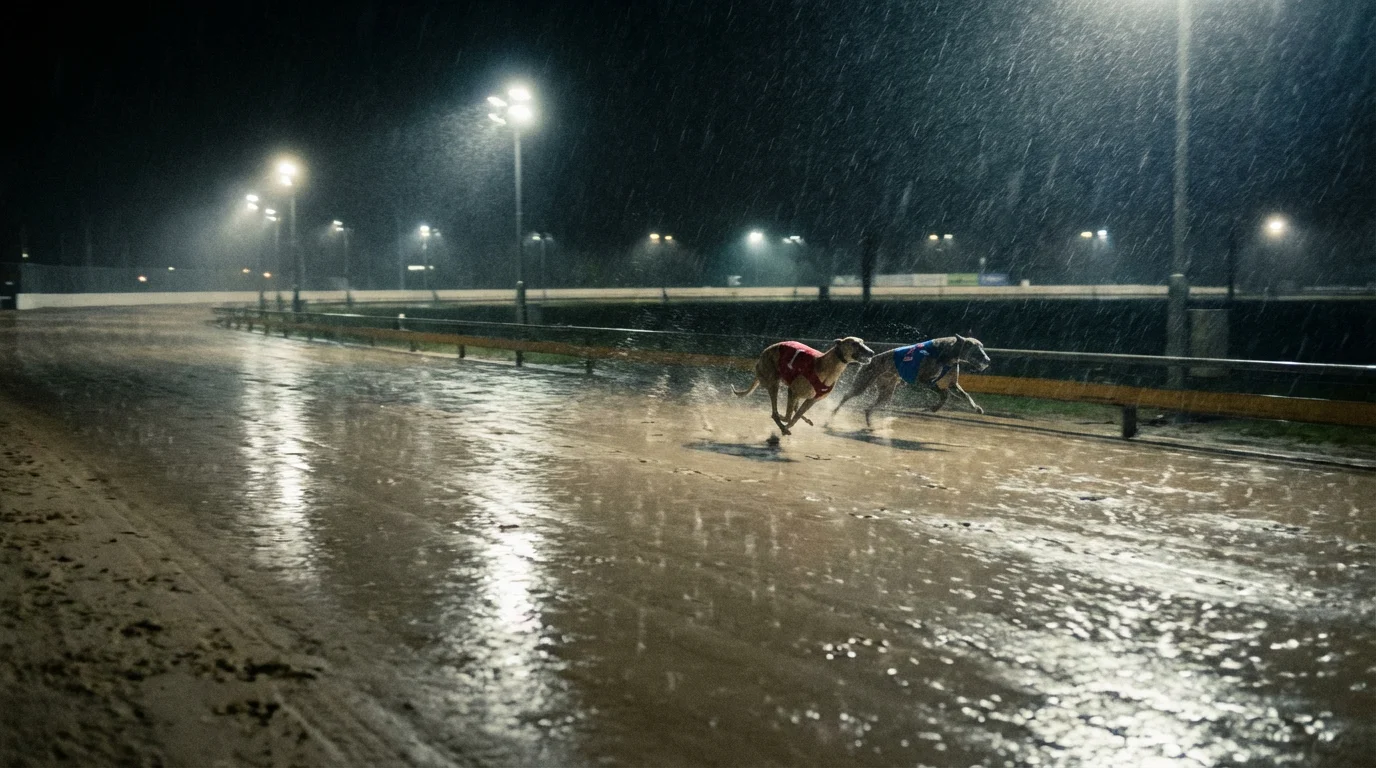
Weather Isn’t Just Atmosphere — It Changes the Race
Rain on the sand, wind against the bend — conditions alter performance in ways the form guide doesn’t capture. Every race card gives you trap draws, sectional times, grades and recent form. What it doesn’t give you is the weather forecast. And yet, the state of the running surface, the strength and direction of the wind, and the ambient temperature all influence how greyhounds run, which traps are favoured, and ultimately, which dog crosses the line first.
Weather is the great unpriced variable in greyhound racing. Bookmakers set their odds based primarily on form and market activity, and while major firms may adjust slightly for conditions, the adjustment is rarely precise. This creates opportunities for punters who make the effort to account for weather before placing their bets. A dog that looks like a 5/1 shot on a dry evening may be closer to 3/1 on a rain-soaked surface if its weight, stride pattern and preferred trap all benefit from the going.
The effect isn’t always dramatic, but over a season of regular betting, incorporating weather data into your analysis provides a small but consistent edge. It’s the kind of advantage that adds up across hundreds of races — not because any single weather adjustment is transformative, but because most of your competition ignores the variable entirely.
This guide covers the three main weather factors that affect greyhound racing — rain, wind and temperature — and explains how each one should influence your pre-race assessment.
Wet Tracks — How Rain Affects Speed and Trap Bias
A wet surface slows all dogs, but it slows lighter dogs more. That asymmetry is the most important principle in wet-track greyhound analysis, and it’s grounded in basic physics. When rain saturates the sand surface, the going becomes heavier. Heavier going demands more effort per stride, and that effort penalises dogs with less body mass. A lean, lighter greyhound that flies on dry sand may labour when the surface is waterlogged, while a heavier, more powerfully built dog that usually lacks the top speed to dominate can find itself better suited to the slog.
This effect has been observed anecdotally for decades and is supported by the track-level data that’s increasingly available to bettors. At tracks where weight data is published or can be estimated from form guides, the correlation between heavier body weight and improved wet-track performance is noticeable. It’s not absolute — a good dog on a bad day still beats a bad dog on a good day — but when two runners are closely matched on dry form, the heavier dog often has the edge when the heavens open.
Rain also affects trap bias. When water drains unevenly across a track surface — which happens more often than track operators would like — certain areas of the running surface become softer than others. At some tracks, the inside rail holds more water than the middle or outside, which disadvantages inside-drawn dogs. At others, the drainage pattern favours the rail. The specific bias depends on the track’s gradient, drainage system and surface composition, and it can change during a meeting as rain continues or stops.
For punters, the practical approach is to watch the early races on a rain-affected card before committing serious money. If the first two or three races show a clear pattern — inside dogs struggling, or outside traps producing unexpected results — that’s the track telling you how the surface is playing. Adjust your bets for the later races accordingly. The early races on a wet card are informational; the later races, armed with that information, are where value emerges.
Sectional times also shift on wet tracks. A universally slower set of sectionals across a card confirms the surface is heavy. If one dog bucks the trend and posts a split close to its dry-track average, it’s handling the conditions better than its rivals — a signal that may not be obvious from the finishing positions alone, particularly in a tightly bunched result.
Wind Factor — Headwinds, Tailwinds and Bend Effects
Wind rarely features in analysis, but at exposed tracks it changes early pace dynamics in measurable ways. Most greyhound stadiums in the UK have some degree of exposure to wind, and the effect is most pronounced on the home straight, where dogs run in a roughly linear path and are fully subject to headwinds or tailwinds.
A headwind on the home straight slows the dogs during the opening phase of the race — the section captured by the sectional time. Every dog is affected, but the impact is greatest on lighter dogs and those with less raw power. A headwind of even moderate strength can add tenths of a second to sectional times, which at greyhound-race margins can change who leads at the first bend. If you’ve built a pace map based on dry, calm conditions, a strong headwind may invalidate your assumption about which dog leads.
Tailwinds create the opposite effect: dogs run faster on the opening straight, and sectionals tighten. The danger here is that tailwinds can flatter dogs with fast early pace by producing artificially quick splits that don’t reflect genuine improvement. A dog that posts a career-best sectional on a night with a strong tailwind hasn’t necessarily found new speed — it’s been pushed.
Wind around the bends is harder to quantify but equally relevant. A crosswind on a bend pushes dogs outward or inward depending on the direction, which can advantage wide runners (pushed onto the rail by the wind) or disadvantage them (pushed wider still). At tracks like Harlow, where the stadium structure provides some shelter on parts of the circuit, the wind effect may vary between different bends — creating subtle tactical advantages for specific traps at specific points in the race.
Checking the wind forecast before a meeting — direction and speed — takes thirty seconds and can inform your trap assessment. Strong winds aren’t common enough to dominate your analysis, but on the nights they occur, ignoring them is a mistake.
Temperature, Humidity and Greyhound Muscle Performance
Greyhounds are sprint animals — and sprinters perform differently in heat. The relationship between temperature and greyhound performance is rooted in muscle physiology. Greyhounds generate enormous amounts of heat during a race. Their muscle fibres, optimised for explosive power, produce metabolic waste heat that needs to be dissipated quickly. In cooler conditions, this heat dispersion is efficient. In warmer conditions, the dog’s body temperature rises faster, which can lead to slightly slower race times and, in extreme cases, thermal distress.
UK greyhound racing rarely encounters the kind of heat that causes serious welfare concerns — summer evenings in Essex are warm, not scorching — but even moderate temperature differences affect race times. Data across multiple UK tracks shows that average finishing times tend to be slightly slower on warmer summer evenings compared to cooler autumn and winter meetings. The difference is small, typically a few tenths of a second over a standard distance, but it’s consistent enough to be worth noting.
Humidity compounds the effect. High humidity reduces the efficiency of evaporative cooling (the greyhound’s primary heat-loss mechanism, which works through panting and circulation to extremities), meaning the dog retains more heat during the race. On humid summer evenings, greyhounds may tire fractionally earlier than on dry, cool nights. For punters, this is most relevant in longer-distance races — 592 metres and above — where the accumulated heat over a longer run duration has more time to affect performance.
Cold weather presents its own considerations. Greyhounds in good condition handle cold well, but very low temperatures can affect muscle flexibility and increase the risk of injury during the explosive start from the traps. Trainers manage this through pre-race warm-ups, but it’s worth noting that dogs returning from winter breaks may need a run or two to reach full fitness in cold conditions.
The temperature effect is a secondary variable — it matters less than form, trap draw or track conditions in most races. But in competitive fields where margins are small, it can be the tiebreaker that separates two closely matched dogs. The dog whose physiology handles the conditions better on that particular evening gets a marginal advantage, and marginal advantages decide close races.
Check the Forecast Before You Check the Form
Weather is the variable that punters forget and bookmakers don’t always price in. That’s a rare combination in betting — an information gap that’s freely available to anyone who spends sixty seconds checking the weather before checking the race card.
The process is simple. Before you open the form guide for tonight’s meeting, check three things: is rain expected, what’s the wind direction and speed, and what’s the temperature going to be at race time? If the conditions are normal — dry, calm, moderate temperature — proceed with your standard analysis. If any of those three factors is unusual — heavy rain, strong wind, unseasonable heat or cold — adjust your thinking before you start assessing individual dogs.
On wet nights, favour heavier dogs and watch the early races for trap bias. On windy nights, adjust your pace maps for the home straight and the bends. On warm evenings, be cautious about dogs in longer races that rely on stamina rather than early speed. These adjustments are small, but they’re based on observable physical effects, not hunches. And over a full season of regular betting, they add up to something that most of your competition simply doesn’t account for.