Greyhound Racing Calendar UK: Key Events and Derbies
Best Greyhound Betting Sites – Bet on Greyhounds in 2026
Loading...
The Greyhound Calendar Runs Year-Round
Unlike horse racing’s stop-start season, greyhound racing never truly pauses. There’s no winter break, no off-season, no months where the sport goes dark. GBGB-licensed tracks across the UK run meetings throughout the year, from January through December, with racing available most evenings and many mornings. For bettors, this means a continuous supply of opportunities — but it also means the calendar has structure and rhythm that rewards those who pay attention to it.
The greyhound racing year is shaped by its major events: the English Greyhound Derby, the St Leger, the Oaks and a constellation of other competitions that anchor the calendar at different points. Around these marquee events, the regular graded programme continues at every track, but the character of the racing shifts. Trainers target their better dogs at big-race entries, which can affect the quality of graded cards at individual tracks. Open-race nights at regional venues gain significance as stepping stones towards major events. The calendar isn’t just a list of dates — it’s a map of where the strongest competition will be and when.
Understanding this map gives you a planning framework for your betting year. You know when the major events are coming, when ante-post markets open, when to expect stronger fields at your local track, and when the regular programme is likely to produce more predictable racing. This guide covers the key events, the regional programme, and the betting angles that the calendar creates.
Major UK Greyhound Events — Derby, St Leger, Oaks
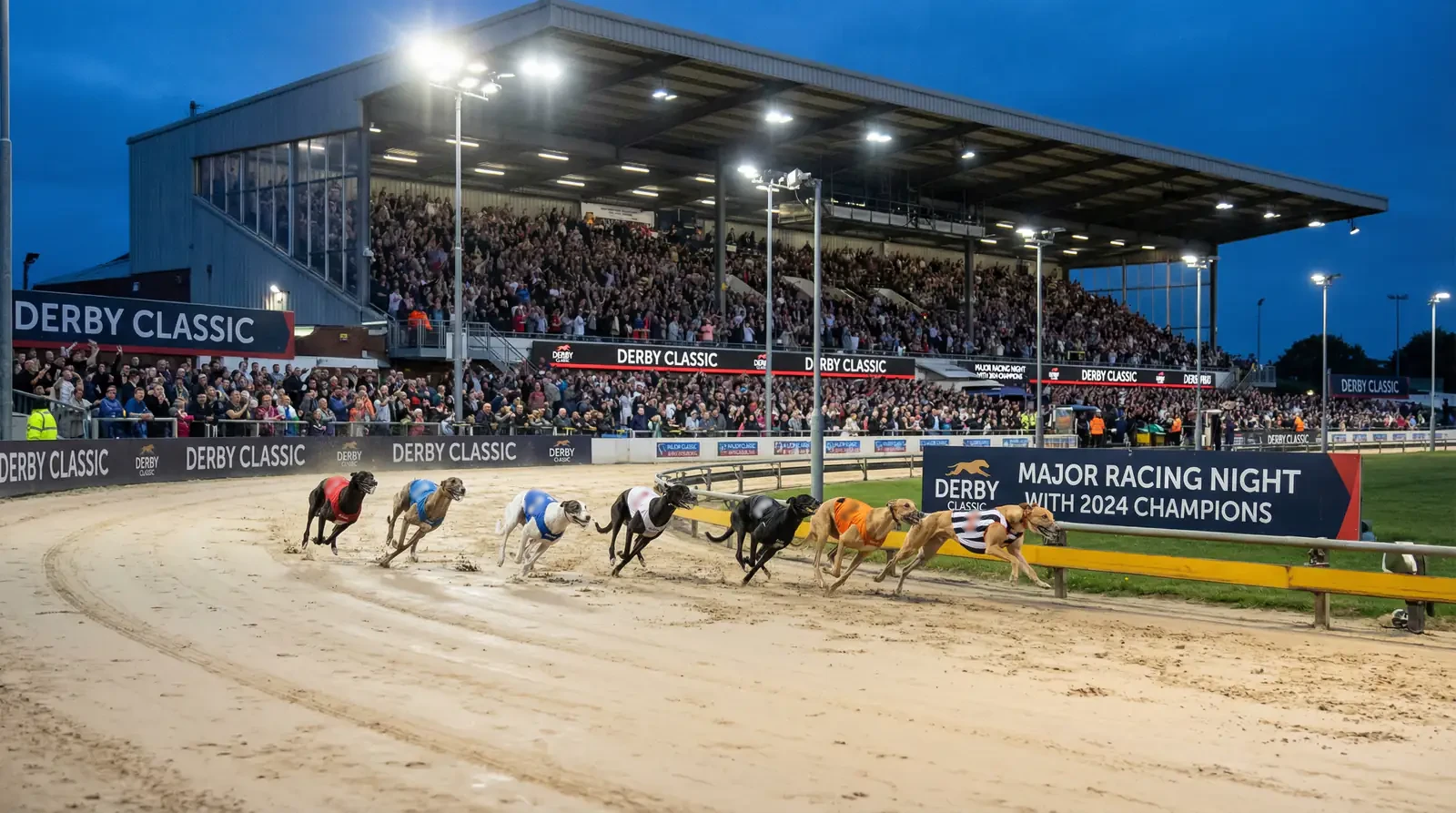
The English Greyhound Derby is the sport’s richest and most watched event. Held at Towcester in Northamptonshire, the Derby attracts the best greyhounds in training and generates the most significant betting activity of the greyhound year. The competition runs through multiple rounds — first-round heats, second-round heats, quarter-finals, semi-finals and the final — spread across several weeks. Each round eliminates runners, and the progression from heats to final creates a narrative arc that builds public interest and betting volume with every stage.
The Derby typically takes place in the summer months, with the final running in late June or July. The prize money — regularly exceeding £175,000 for the winner — makes it the most lucrative single race in UK greyhound racing. The track’s standard distance of 500 metres is used for the competition, and the quality of the fields is consistently the highest in the sport. Betting markets for the Derby are the deepest in greyhound racing, with ante-post markets opening weeks before the first heat and prices fluctuating as the rounds progress and the field narrows.
The Greyhound St Leger is the sport’s oldest classic, currently held at Nottingham. The St Leger is a stayers’ event, run over 730 metres, which tests a different set of attributes than the Derby’s standard trip. Dogs that contest the St Leger tend to be stronger stayers, and the competition attracts a specialist pool of runners. For bettors, the St Leger offers a distinct form challenge because the middle-distance form book is thinner than the standard-distance one, and dogs stepping up in trip for the first time are harder to assess.
The Greyhound Oaks mirrors the Derby structure but is restricted to bitches. It’s typically held in the autumn and provides a showcase for the top female greyhounds in training. The Oaks carries significant prize money and prestige, though it attracts less betting volume than the Derby. From a punting perspective, the Oaks can offer value precisely because it receives less market attention — the odds are sometimes softer than they would be on an equivalent open event.
Beyond the three classics, the greyhound calendar includes events like the Coronation Cup, the Gold Cup, the Eclipse and numerous other competitions at tracks across the country. Each carries its own history, its own distance and its own entry criteria. Collectively, these events provide a year-round framework of premium racing that sits above the regular graded programme.
The key dates shift slightly year to year depending on scheduling decisions by the GBGB and individual tracks. The Racing Post and the GBGB website publish confirmed dates once they’re set, usually several months in advance. Bookmarking these dates at the start of each year allows you to plan your betting calendar around the events that matter most.
Regional Open Races and Track Championships
Beyond the derbies, individual tracks host open-race nights with enhanced competition. These events are the tier below the national classics but above the regular graded programme, and they matter to punters for two reasons: the fields are stronger than standard graded racing, and the betting markets are often more liquid.
Harlow, like most GBGB-licensed tracks, schedules periodic open-race nights throughout the year. These events invite runners from outside the regular racing pool, which means the field includes dogs that don’t normally compete at the track. This unfamiliarity adds a layer of analytical difficulty — you can’t rely on track-specific form data for visiting dogs — but it also creates pricing opportunities. Bookmakers may price open-race runners based on their form at other tracks, which doesn’t always translate accurately to the conditions at the host venue.
Track championships are another category of enhanced competition. Some tracks run an annual championship — a series of heats and a final that determine the best dog at that venue over the season. These events generate local interest and often produce some of the best racing of the year at that specific track. For punters who follow a single track closely, the championship rounds are premium betting opportunities because your accumulated knowledge of the track, the dogs and the conditions is at its most valuable.
Regional open races also serve as trials and stepping stones for national events. A dog that performs well in an open race at Harlow might be entered for the Derby or St Leger heats later in the year. Tracking which dogs are being aimed at major events — by monitoring open-race entries and results — gives you early intelligence on potential Derby contenders before the ante-post market has fully formed.
Ante-Post Betting on Major Greyhound Events
Ante-post markets open weeks before the Derby final — but all-in rules apply. Ante-post betting on greyhound events follows the same principles as horse racing ante-post markets: you can back a dog well in advance of the race, often at much longer odds than will be available on the day, but if the dog doesn’t make the final — for any reason — your bet loses.
This “all-in, run or not” condition is the defining risk of ante-post greyhound betting. In a competition that runs through multiple rounds, dogs can be eliminated at any stage. Injury, poor form in earlier rounds, or tactical withdrawal by the trainer all mean your selection might not reach the final. There’s no refund in ante-post markets — if the dog doesn’t run in the final, your stake is gone.
The reward for accepting this risk is access to prices that are typically much more generous than the day-of-race odds. A dog that’s 20/1 ante-post might be 5/1 by the time it reaches the final, particularly if it wins its heats impressively and attracts market support. Backing at the ante-post price locks in value that isn’t available later. The trick is assessing not just whether the dog can win the final, but whether it’s likely to make the final — and that requires knowledge of the competition format, the likely quality of its heat opponents, and the trainer’s intentions.
Ante-post markets for the English Greyhound Derby are the deepest and most liquid, with most major bookmakers offering prices from the time the entry list is published. Other events have thinner ante-post markets, sometimes limited to a handful of operators. For events with limited ante-post coverage, the prices can be less accurate, which creates opportunity for punters who’ve done their homework.
A practical tip: monitor the early rounds of major events closely, even if you’re not betting ante-post. The heat results give you form data that’s directly relevant to the final, and the way prices move through the rounds tells you which dogs the market rates and which are being overlooked. By the time the final arrives, you’ll have a much richer understanding of the field than a punter who only engages on the day of the race.
Mark the Dates, Watch the Entries
The racing calendar is your planning framework — align your bankroll and form study to it. The year has a rhythm: regular graded racing provides the baseline, open-race nights at your local track offer premium opportunities, and the major national events anchor the calendar at specific points.
At the start of each year, note the approximate dates of the Derby, St Leger and Oaks. Track when your local venue schedules its open-race nights and championship rounds. Adjust your bankroll allocation so you have more to commit during these premium periods and less riding on the standard midweek graded cards that fill the gaps between them.
The greyhound calendar rewards preparation more than reaction. The punter who marks the dates in January and builds towards them methodically will outperform the one who discovers the Derby semi-finals are on tonight and scrambles to form an opinion. The information is public, the dates are published, and the structure repeats with enough consistency that planning is straightforward. The only requirement is that you actually do it.