Live Greyhound Streaming: Where to Watch UK Races
Best Greyhound Betting Sites – Bet on Greyhounds in 2026
Loading...
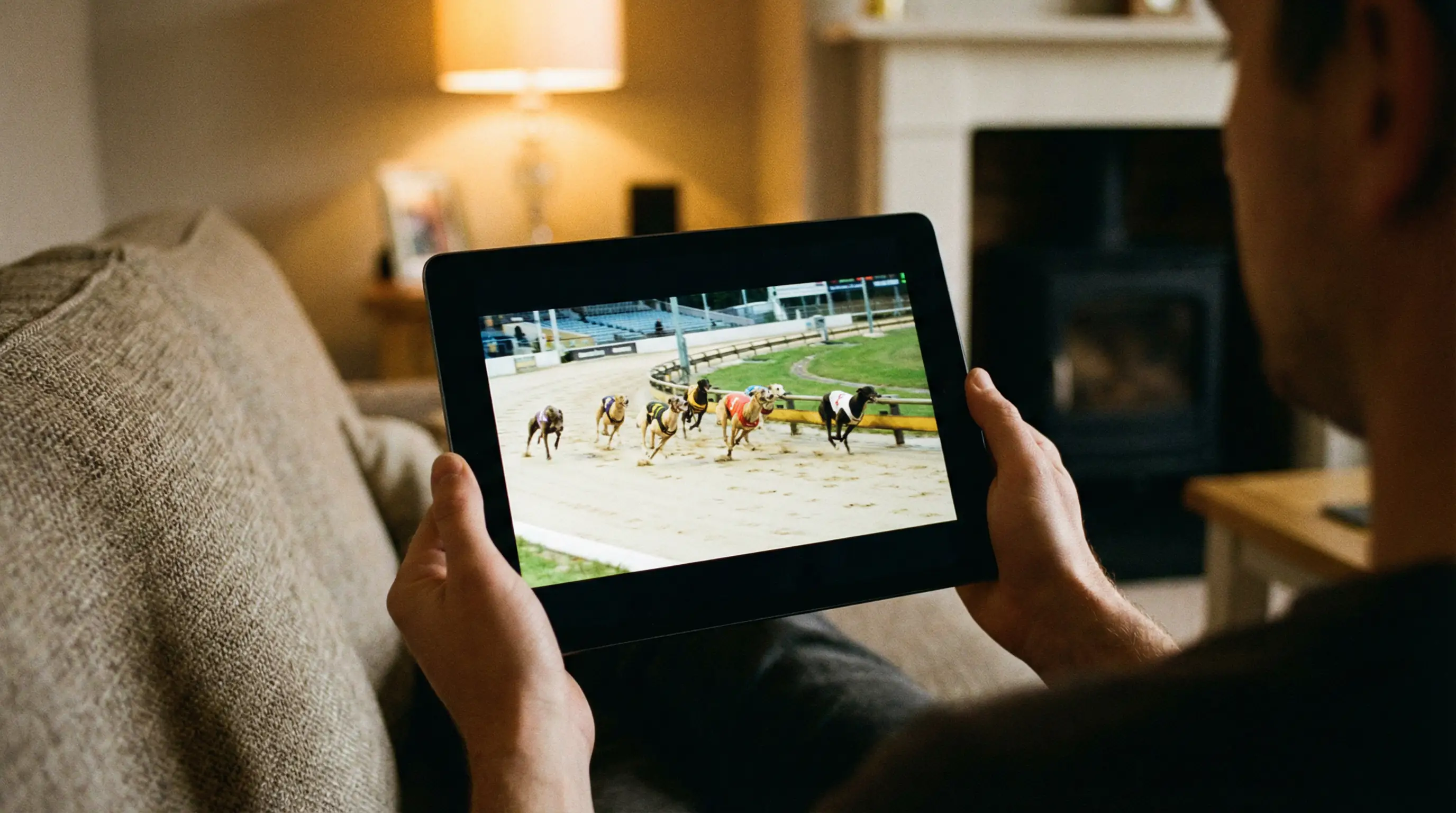
Watching Races Live Changes How You Bet
Live streaming turns data into context — you see what numbers can’t show. A race card tells you a dog was “bumped at the second bend” in its last outing. Watching the replay shows you whether that bump was a minor brush that barely affected the dog’s stride or a full-body collision that cost three lengths and took the dog completely out of contention. The difference between those two scenarios has entirely different implications for form analysis, and you can only distinguish them by watching.
For decades, following greyhound racing from home meant relying on results, race comments and the occasional televised meeting. That changed fundamentally when bookmaker streaming and dedicated racing channels made live coverage available for virtually every GBGB meeting in the UK. Today, any punter with a smartphone or laptop can watch every race at Harlow, Romford, Crayford or any other licensed track without leaving the house.
This access has levelled the playing field between on-course regulars who watched every race in person and home-based punters who relied on printed form. But access alone isn’t enough. Knowing where to find streams, understanding the differences between platforms, and — most importantly — knowing what to look for when you watch are what transform streaming from passive entertainment into an active analytical tool.
Where to Watch UK Greyhound Racing Live
Sky Sports Racing, RPGTV, and bookmaker streams cover the majority of UK meetings. Each platform offers different levels of coverage, access requirements and quality.
Sky Sports Racing is the most prominent dedicated racing channel in the UK. Available through Sky, Virgin Media and NOW TV subscriptions, it broadcasts a selection of greyhound meetings alongside its horse racing coverage. The channel focuses on the larger, more commercially significant meetings — events at tracks with strong broadcast contracts. The production quality is high, with professional commentary, camera angles and pre-race analysis. If you’re a Sky subscriber, the greyhound coverage is included in your package at no additional cost.
RPGTV (Racing Post Greyhound TV) is the specialist channel for greyhound racing. It broadcasts a wider range of meetings than Sky Sports Racing, including cards that the mainstream channel doesn’t cover. RPGTV is available through some satellite and cable packages and also streams online. For punters who follow greyhound racing seriously, RPGTV is the more comprehensive source — it covers more meetings, more tracks and more of the routine graded racing that forms the backbone of the sport.
SIS (Satellite Information Services) provides the live feeds that power most bookmaker streams and betting-shop screens. SIS covers virtually every BAGS and GBGB meeting, making it the most complete source of greyhound racing footage in the UK. You won’t interact with SIS directly as a consumer, but the feed you see on your bookmaker’s app or in a betting shop is almost certainly an SIS production. The coverage is functional rather than glamorous — clean camera angles, basic commentary — but it captures every race at every licensed meeting.
The key distinction between these sources is completeness. Sky Sports Racing covers selected premium meetings. RPGTV covers most evening and open-race meetings. SIS covers everything, and that feed is what bookmakers use for their streaming services. If comprehensive coverage matters to your betting approach, bookmaker streaming (powered by SIS) is the most reliable way to watch every race at every meeting.
Bookmaker Streaming — Free with a Funded Account
Most major bookmakers stream greyhound meetings if you have a balance or a pending bet on the meeting. This makes bookmaker streaming the most accessible option for the majority of UK greyhound bettors — you don’t need a separate subscription, just an active account with funds.
The exact access requirements vary by operator. Some bookmakers require only a positive account balance of any amount — even £1. Others require a placed bet on the specific meeting being streamed. A few restrict streaming to certain meeting types or times. Check your bookmaker’s streaming terms before relying on it, because being locked out of a stream thirty seconds before a race because you didn’t have a qualifying bet is an avoidable frustration.
Stream quality varies meaningfully between bookmakers, and it’s worth testing before you commit to a primary platform. The best streams deliver HD video with a delay of only a few seconds. The worst offer low-resolution feeds with delays of ten seconds or more. For post-race review and general form watching, even a mediocre stream is useful. For any time-sensitive decision — assessing late market movements, watching the parade for visual cues, or evaluating track conditions in real time — quality and latency matter.
Mobile streaming is where most punters watch most of their races. If you bet primarily on your phone, the bookmaker’s app is your streaming interface. App quality differs substantially: some apps offer smooth, stable video that adjusts to your connection speed; others buffer constantly or crash during peak times. Spend a meeting testing the stream on your phone before relying on it for decisions. Wi-Fi is generally more stable than mobile data for streaming, but a strong 4G or 5G signal works well for most bookmaker feeds.
One practical consideration: running a live stream and placing bets on the same device means switching between the stream and the bet slip. Some apps handle this smoothly with picture-in-picture or split-screen modes. Others force you to close the stream to access the betting interface. If simultaneous streaming and betting is important to your process, choose a bookmaker whose app supports it.
Having accounts with two or three bookmakers gives you backup options if one stream fails. Technical issues are rare but not unknown, and losing your feed mid-meeting because of a server problem is less painful when you can switch to an alternative within seconds.
What Live Watching Reveals That Data Doesn’t
Running style, trouble in running, and track conditions — all visible live, none fully captured by the numbers.
The most valuable information from live watching is running style in context. Race cards describe a dog as a “railer” or “wide runner,” but watching the dog run shows you how pronounced that tendency is. Some railers hug the rail so tightly that they struggle when another dog is between them and the fence. Others run near the rail but can adjust when crowded. That difference doesn’t appear in the form figures but is immediately obvious on screen.
Trouble in running is the second major insight. Race comments note interference — “bumped second bend,” “checked first bend,” “slowly away” — but they don’t convey severity. Watching the incident shows you whether the dog lost half a length or three lengths, whether it recovered stride quickly or was affected for the remainder of the race. This granularity changes how you interpret the form figure associated with that run. A dog that finished fourth after losing three lengths to a first-bend collision may be a much better prospect next time than its finishing position suggests.
Track conditions are the third element that live watching captures better than data. If you tune in for the first race of a meeting and notice that rain is falling, that the surface looks darker and heavier than usual, or that the dogs are throwing up more sand than normal, you have real-time condition information that may not be reflected in the data until after the meeting. Using this live visual assessment to adjust your bets for later races on the card is one of the simplest edges available to streaming punters.
Finally, live watching builds pattern recognition over time. After watching hundreds of races at a specific track, you develop an intuitive understanding of how the race flows — which traps produce clean breaks, where crowding typically occurs, how the bends play in different conditions. This accumulated visual knowledge complements the statistical analysis and, in marginal cases, may be the factor that tips your decision.
Stream, Watch, Learn, Then Bet
The more meetings you watch, the better your eye becomes — and the better your selections get. Live streaming isn’t a passive activity for the punter who uses it properly. It’s an information-gathering exercise that feeds directly into your form analysis, your race-reading ability and your understanding of the track.
Start by watching full meetings at your primary track, even the races you’re not betting on. Use the non-betting races as observation sessions: note which traps produce clean breaks, watch how dogs navigate the bends, pay attention to the surface and conditions. Then, when you return to the form guide for the next meeting, the numbers will carry visual context that makes them richer and more useful.
The investment is time, and the return compounds. There’s no shortcut to a trained eye — it develops through repetition. But the punter who watches two meetings a week at Harlow for six months will read form with a depth that no amount of data-only analysis can replicate. The stream is the most underused tool available to modern greyhound bettors. Use it.