How Greyhound Sectional Times Work
Best Greyhound Betting Sites – Bet on Greyhounds in 2026
Loading...
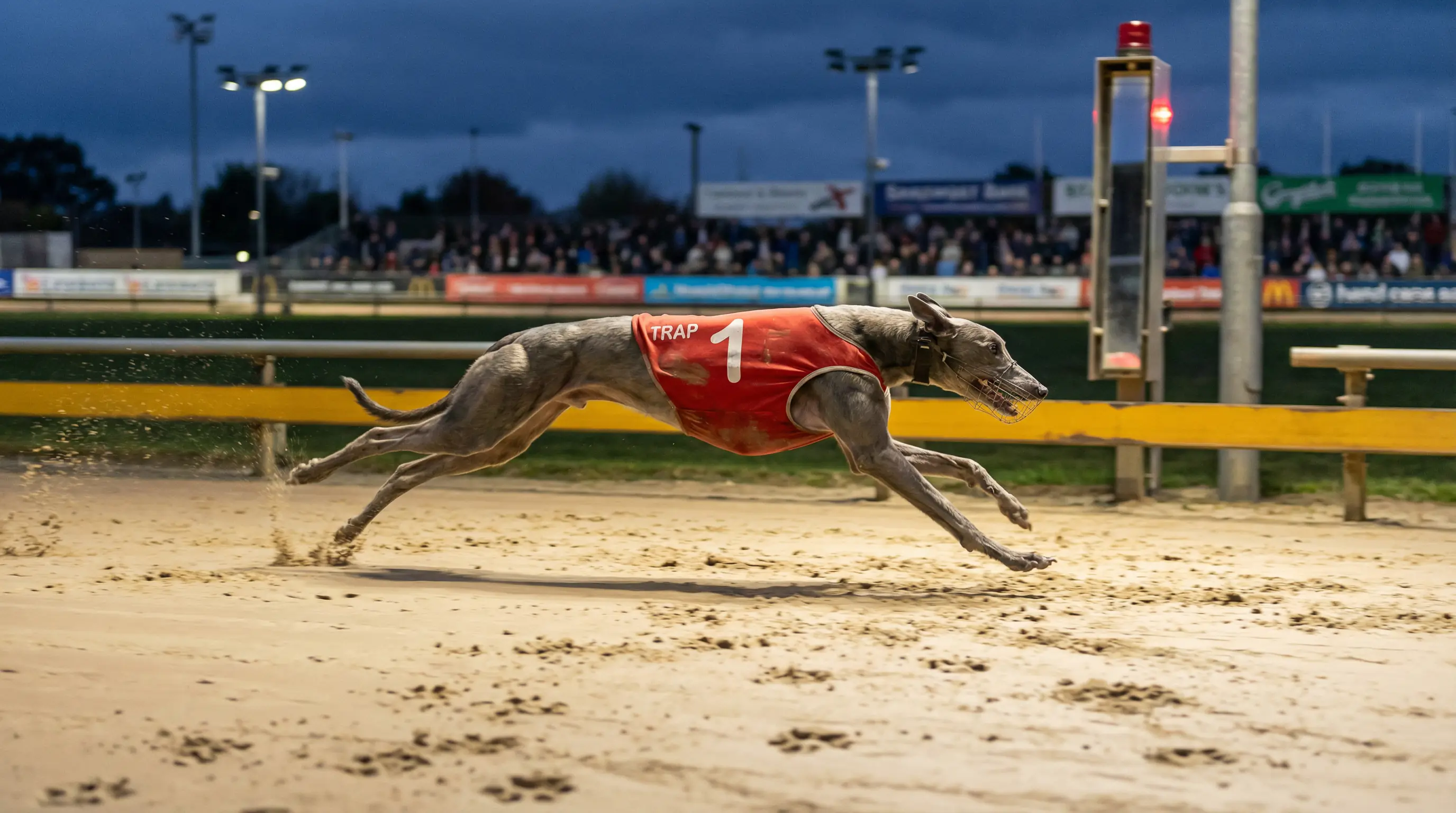
Sectional Times Measure Pace, Not Just Speed
A dog’s sectional time is the first real indicator of how a race unfolded — and it tells you something that the finishing position alone never can. Two dogs might both finish second in back-to-back races, but if one posted a sectional of 3.18 and the other clocked 3.42, their races played out in fundamentally different ways. The first was leading or pressing the pace from the traps; the second was likely caught behind traffic and running on late. That difference matters enormously when you’re trying to project how those dogs will perform next time out.
Sectional times — also called split times or simply “splits” — record the time a greyhound takes to travel from the traps to a specific point on the track, usually the winning line on the first pass. They’re distinct from the overall finishing time, which measures the full race from start to finish. The sectional captures the opening phase of a race: the break, the early running, and the approach to the first bend. For punters, it’s the closest thing to an X-ray of a dog’s tactical profile.
Understanding sectionals is not optional for serious greyhound bettors. They’re printed on race cards, published in results, and discussed in every serious form analysis. If you’re not using them, you’re ignoring one of the most accessible and predictive data points available.
This guide explains what sectional times are, how they’re measured, why they can’t be compared across tracks without adjustment, and how to incorporate them into your pre-race analysis.
What Sectional Times Are and How They’re Measured
The sectional — or split — is the time from the traps to the winning line on the first pass. At most UK tracks, this is measured electronically using photo-finish and timing equipment positioned at the line. The dog breaks from its trap, runs the length of the home straight, and crosses the winning line for the first time. The clock stops there, and that interval is the sectional.
The distance covered in a sectional varies by track because the winning line’s position relative to the traps differs from circuit to circuit. At Harlow, the home straight and winning line position mean the sectional covers roughly the first 100 to 120 metres of the race, depending on the trap position and the dog’s line of running. At larger tracks with longer straights, the sectional distance may be greater. This is why cross-track comparisons require caution — a 3.20 sectional at Harlow and a 3.20 sectional at Nottingham don’t represent the same distance or the same effort.
The timing system records the sectional for every dog in the race, but the figure you’ll most commonly see on a race card is each individual runner’s split from its own trap to the line. Some results services also publish the first-bend position alongside the sectional, which adds context: a dog might post a quick sectional but still be third at the first bend because its line of running took it wide.
Calculated sectionals exist too. Just as finishing times are adjusted by the racing office to account for interference, sectional times can be adjusted when a dog was clearly impeded during the opening phase. A dog that stumbled at the break or was bumped leaving the traps might have its sectional adjusted to reflect its likely split without interference. When analysing form, note whether the sectional listed is the actual recorded split or a calculated figure — the distinction matters for accuracy.
There’s one more layer of precision worth understanding. Some race cards list the sectional to two decimal places (3.18 seconds), while others round to one (3.2 seconds). The granularity depends on the timing equipment and the reporting service. For analysis purposes, two-decimal-place figures are preferable because the difference between 3.18 and 3.22 — four hundredths of a second — can represent a meaningful gap in early pace over such a short distance.
Interpreting Sectionals Across Different Distances
A 3.20 split at one track doesn’t compare directly to 3.20 at another. This is the most common interpretive error punters make with sectional data, and it stems from a natural but incorrect assumption: that the same number means the same thing everywhere.
The sectional measures time over a variable distance. The winning line at Harlow is in a different position relative to the traps than at Romford, Crayford, or any other track. Even at the same track, the actual distance from each trap to the winning line differs slightly — Trap 1 on the inside has a marginally shorter path than Trap 6 on the outside, though the difference is usually small enough to be negligible.
What this means in practice is that sectional times are only reliably comparable within the same track. If you’re analysing a dog that’s raced at Harlow six times and posted sectionals of 3.18, 3.22, 3.19, 3.25, 3.20 and 3.17, you can draw conclusions about its consistency of early pace at that track. If the same dog then moves to Monmore and posts a 3.35, you can’t assume it’s slowed down — the sectional distance at Monmore may simply be longer.
Race distance also affects how you should interpret sectionals. At sprint distances (238 metres at Harlow), the sectional represents a larger proportion of the total race. A fast split in a sprint means the dog was flying from the traps, and because the race is short, that early speed translates directly into finishing position. At marathon distances (946 metres), the sectional still tells you about early pace, but the race has enough duration for later speed and stamina to override whatever happened in the opening phase.
Track conditions influence sectional times as well. A rain-softened surface slows all dogs, and the effect shows up in sectionals before it shows up in finishing times. If every dog in a race posts a sectional half a second slower than its recent average, the track is running slow. Factoring this in prevents you from penalising dogs for conditions that affected the entire field.
The most useful approach is to track sectionals relative to the average for each track and distance. If the average sectional at Harlow over 415 metres is around 3.22, a dog posting 3.15 consistently is significantly quicker than average out of the traps. That comparative assessment is more valuable than the absolute number.
Using Sectionals in Your Pre-Race Analysis
Combine sectionals with first-bend position for a complete pace picture. The sectional tells you who gets to the line quickest on the first pass; the first-bend position tells you who actually leads going into the turn. Together, they reveal the tactical shape of a race before it happens.
Start by listing each runner’s average sectional from their last three or four races at the same track. Identify which dog is likely to show the most early pace. Then check the first-bend positions from those runs — did the dog with the quickest split actually lead at the bend, or did it get crowded out despite its speed? A dog that posts fast sectionals but regularly ends up third or fourth at the bend may be trapping quickly but running a wide line that costs it position.
Once you’ve identified the likely pace scenario, ask how the rest of the field fits around it. If one dog has a clear sectional advantage from a suitable trap, the race may be straightforward — that dog leads, controls the pace, and the others have to produce something exceptional to overhaul it. If two or three dogs have similar sectionals and they’re drawn close together, crowding at the first bend becomes a real possibility, which opens the race up for a dog further back with a clearer run.
Sectionals are also useful for identifying improving dogs. A greyhound whose sectionals have tightened across its last three runs — from 3.28 to 3.23 to 3.19, for instance — is sharpening up, probably gaining fitness after a break or adjusting to a new track. That trend might not show clearly in finishing positions, especially if the dog has been racing in strong grades, but the sectional improvement suggests it’s close to a peak performance.
Finally, be wary of one-off fast sectionals. A dog that posts 3.12 once but normally clocks 3.22 probably had an unusually clean break rather than a genuine improvement. Consistency of sectional times is more reliable than a single fast figure. Use the average and the range, not the peak, when building your pace model.
The Split Second That Splits the Field
Sectionals separate the dogs before the first bend — and they separate the punters who notice from those who don’t. The data is there on every race card, in every set of results, available to anyone who looks. The edge isn’t in accessing it — it’s in using it systematically.
At tracks like Harlow, where the first bend arrives quickly and early pace carries disproportionate weight, sectional analysis isn’t just useful — it’s close to essential. The dogs that clock the fastest splits from favourable traps win more than their fair share of races. The dogs that show improving splits are approaching their best. The dogs whose sectionals don’t match their finishing positions have stories worth investigating.
A few hundredths of a second at the start of a race can determine lengths at the finish. That’s the scale you’re working with. Make the sectional the first number you check on every race card, and the last number you verify before placing a bet.