Greyhound Trap Colours and Numbers Explained
Best Greyhound Betting Sites – Bet on Greyhounds in 2026
Loading...
Why Trap Numbers and Jacket Colours Matter
Six traps, six colours — and each one carries statistical weight. The numbering and colour system in UK greyhound racing isn’t decorative. It serves two purposes: it lets spectators and bettors identify dogs instantly during a race, and it defines the starting position on the track, which has a measurable effect on outcomes.
For casual spectators, the coloured jackets are a visual shorthand. For punters, they’re a critical variable. A dog’s trap number determines its position relative to the rail, the first bend, and the other five runners. That position, combined with the dog’s running style, creates advantages and disadvantages that show up clearly in the statistics. Ignoring the trap draw is like picking a horse without checking its stall position — you’re missing one of the most influential factors in the race.
Understanding the trap system also helps when you’re watching races live or reviewing results. Commentators reference trap colours constantly, and race cards list trap positions as the primary identifier alongside the dog’s name. If you can’t immediately associate Trap 4 with a black jacket, you’re working slower than you need to be.
This guide covers the standard UK numbering and colour system, explains how trap position influences race dynamics, and addresses what happens when reserves step in or traps are left vacant.
The UK Trap Numbering and Colour System
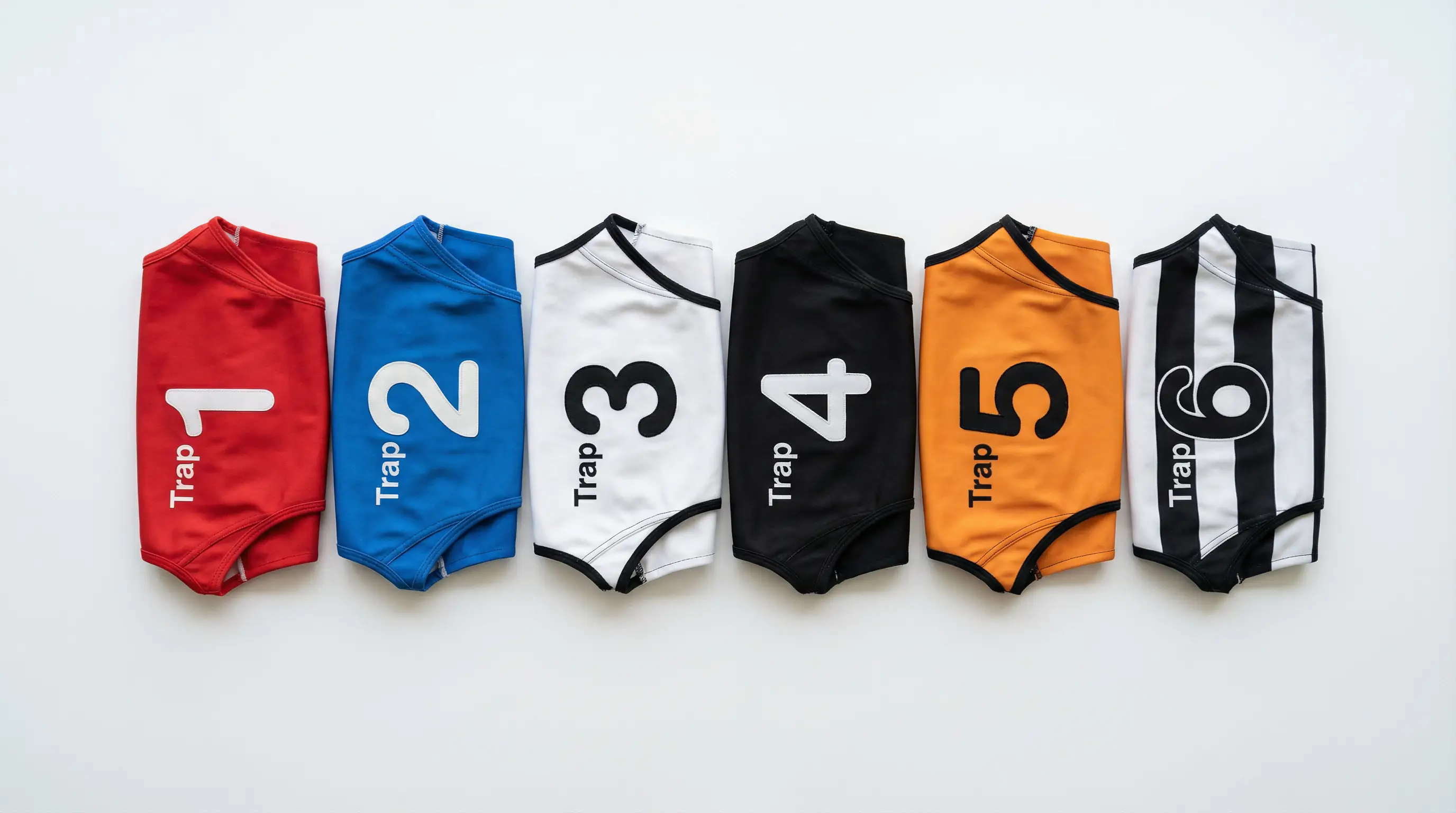
Every GBGB-licensed track in the UK uses the same trap numbering and jacket colour scheme. There are six traps, numbered one through six, running from the inside rail outward. Each number has a fixed colour that never changes regardless of the track, the meeting or the grade of race.
| Trap | Jacket Colour | Position |
|---|---|---|
| 1 | Red | Inside rail |
| 2 | Blue | Second from rail |
| 3 | White | Middle inside |
| 4 | Black | Middle outside |
| 5 | Orange | Second from outside |
| 6 | Black and white stripes | Outside |
The colour coding is universal across all tracks. Whether you’re watching at Harlow, Romford, Nottingham or any other licensed stadium, Trap 1 always wears red and Trap 6 always wears the distinctive black-and-white striped jacket. This consistency is deliberately maintained to prevent confusion, particularly at tracks that host televised racing where viewers need to identify dogs at speed.
The jacket is placed over the dog’s back before the race and covers the torso. The trap number is printed on both sides. In combination with the colour, this creates a system that works both in person and on screen. Even on a grainy live stream, you can track which dog is which by the jacket colour alone — something that becomes second nature after watching a few meetings.
It’s worth noting that some tracks outside the UK use different colour schemes. Irish tracks follow a similar system but with slight variations in the order. Australian tracks use eight traps with a different colour set entirely. If you’re betting across borders, don’t assume the colours match.
The trap numbering also appears on race cards alongside the dog’s name, trainer, recent form and other data. When analysing a card, the trap number is typically the first piece of information listed for each runner — a reflection of how important the starting position is to the race outcome.
How Trap Position Affects Race Outcomes
Inside traps have a shorter run to the first bend — but that advantage isn’t universal. The impact of trap position depends on the track layout, the race distance, and crucially, the individual running style of the dog.
At most UK tracks, the traps are positioned on the home straight, meaning dogs break from a standing start and run towards the first bend. The dog in Trap 1 has the shortest path to the rail, while the dog in Trap 6 has the widest arc to navigate. In theory, Trap 1 should win more often. In practice, the picture is more nuanced.
Dogs are classified by their running style: railers prefer the inside line and gravitate towards the rail, middle runners hold their line through the bends, and wide runners take the outside path. When a railer draws Trap 1, it’s a natural fit — the dog breaks, moves to the rail immediately, and takes the shortest route into the first bend. When a wide runner draws Trap 1, it needs to cross traffic to get to its preferred position, which creates interference for itself and other dogs.
This is why raw trap statistics can be misleading. Trap 6 at Harlow, for instance, wins approximately 21% of races — higher than any other trap at that track. The reason isn’t that Trap 6 is inherently advantaged. It’s that racing offices at Harlow tend to seed wide runners into Trap 6, giving those dogs a draw that suits their style. When the seeding works, the statistics follow.
At sprint distances — 238 metres at Harlow, for example — the trap draw is even more influential because the first bend arrives quickly. There’s less time for dogs to sort themselves into natural positions, so the initial break from the traps and the run to the first bend can determine the entire outcome. At longer distances, the trap draw still matters for the first bend, but the race has enough duration for running style and stamina to reassert themselves.
The practical takeaway for bettors is straightforward: never assess a dog’s chance without cross-referencing its running style against its trap draw. A fast dog in the wrong trap is a different proposition from a fast dog in the right one. Race cards indicate running style with letters — “r” for railer, “m” for middle, “w” for wide — and using that information alongside the trap number is fundamental to competent form analysis.
Reserve Runners and Re-Drawn Traps
When a dog is scratched from a race — whether due to injury, illness, season (for bitches) or trainer withdrawal — the vacant trap isn’t always refilled. If a suitable reserve is available, it takes the withdrawn dog’s trap position. If no reserve is available, the race runs with an empty trap.
A reserve runner is identified on the race card by the letter “R” next to its name, and it wears the jacket colour of the trap it occupies, not any previous trap it may have been drawn in. This means the reserve might be running from a trap that doesn’t suit its style. A railer drawn as a reserve for Trap 5, for example, faces a fundamentally different tactical challenge than it would from Trap 1.
For bettors, reserve runners are a double-edged signal. On one hand, a reserve that suits its inherited trap can be undervalued by the market because punters haven’t had time to reassess the race. On the other hand, a reserve in an unsuitable trap is a potential liability — particularly if it disrupts the running of dogs around it.
Empty traps are equally important. A vacant Trap 3, for instance, gives the dog in Trap 4 more room on the inside and effectively shifts the balance of the race. Dogs adjacent to empty traps often benefit from reduced interference at the break, which can translate into better first-bend positions. Some punters actively look for races with late withdrawals and vacant traps as a source of value, particularly at smaller tracks where the impact is more pronounced.
Always check for late changes before placing a bet. The card you studied the night before may not be the card that runs. A withdrawn favourite, a reserve substitution, or a vacant trap can change the dynamics of a race enough to invalidate your original assessment.
The Jacket Tells You the Starting Point — Form Tells You the Rest
Colour alone is decoration; combined with data, it’s a signal. Knowing that Trap 1 is red and Trap 6 is striped is table stakes. The edge comes from understanding what each trap means at a specific track, over a specific distance, for a specific type of runner.
At Harlow, the relationship between trap position and outcome is well-documented and statistically robust. Punters who study the trap-by-distance data — not just the overall figures — develop a sharper read on race dynamics than those who rely on headline statistics. A 21% win rate for Trap 6 is informative. A 25% win rate for Trap 6 over 415 metres, compared to 14% over 238 metres, is actionable.
The trap system is the framework. The form guide fills it in. The jacket gets the dog to the start — everything after that is racing. Learn the colours, understand the positions, and then do the actual work of analysing the dogs that wear them.